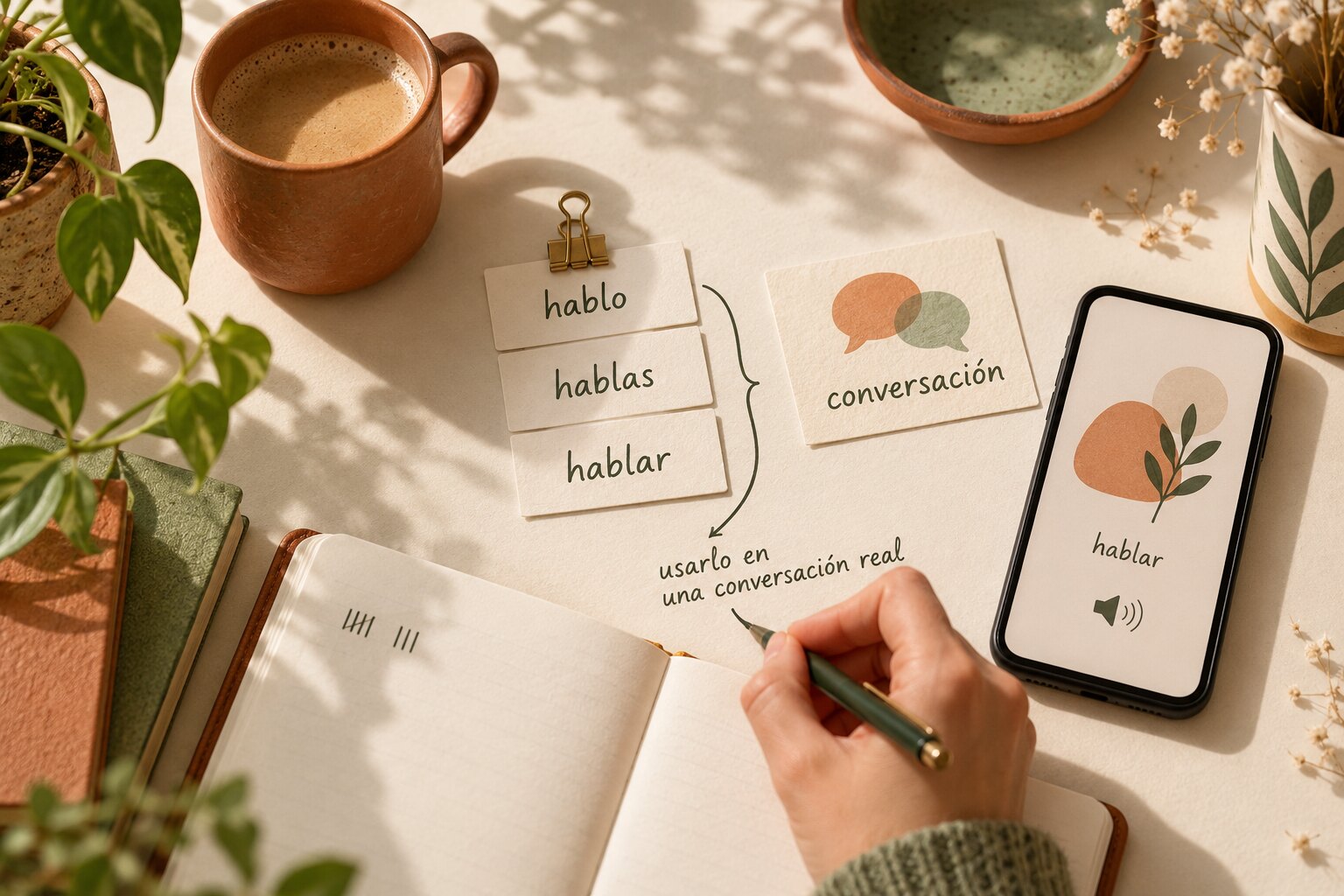
Study Sentence Library
Copy these study sentences to your notebook for optional offline practice. These examples are separate from the prebuilt audio vocabulary cards in the app.
how many words to be fluent in Spanish
Linguistic Units: Tokens, Types, Lemmas, and Families
Quantifying vocabulary requires separating four units. A token is an individual word occurrence in running text. A wordform or type is a distinct spelling. A lemma groups inflectional variants under one base headword. Derivational families group lemmas sharing a root, though learners rarely know derived forms automatically. Multiword expressions convey single meanings across multiple tokens.
Consider this lowercase, punctuation-free passage under whitespace separation: un músico toca música y dos músicos tocan música. Counting occurrences yields nine tokens. Unique spellings give eight wordforms, as música repeats. Grouping inflections leaves six lemmas: uno, músico, tocar, música, y, and dos. Finally, músico and música share a derivational family root despite being distinct lemmas.
Recognition, Retrieval, and Inflections
Vocabulary competence spans distinct abilities—receptive recognition, unaided recall, and connected communication—rather than a rigid universal stage progression. Receptive recognition means understanding a word when reading or listening with context. Unaided recall requires retrieving the Spanish word from a meaning prompt without seeing the Spanish term. Connected communication means deploying vocabulary spontaneously in live dialogue alongside accurate grammar, pronunciation, and listening comprehension.
Knowing a lemma does not mean mastering all its forms. The regular verb lemma cantar includes grammatical inflections like canto, cantas, and cantó. In contrast, the transparent derived noun cantante is a related derivative in the wider word family, not part of the verb lemma. A learner recognizing the infinitive may still struggle to conjugate tenses or recall related derivatives during speech. Communicative ability requires practicing both inflections and derivatives in context.
12 Examples of Spanish Words in Sentence Context
Review these twelve sample sentences to see how words function across forms, syntax, and active use. These provide optional written practice.
| Spanish | Meaning |
|---|---|
| El profesor abre la puerta. | The teacher opens the door. |
| Nosotros abrimos las ventanas hoy. | We open the windows today. |
| La apertura de la tienda fue ayer. | The store opening was yesterday. |
| Mi amigo ha abierto el libro. | My friend has opened the book. |
| Ella lee un libro en casa. | She reads a book at home. |
| Mi amigo escribe una carta breve. | My friend writes a short letter. |
| No tenemos tiempo para leer. | We do not have time to read. |
| Ellos buscan una casa nueva. | They are looking for a new house. |
| Siempre uso palabras sencillas con amigos. | I always use simple words with friends. |
| Conversamos sobre la lección en clase. | We chat about the lesson in class. |
| Ella comparte palabras amables con todos. | She shares kind words with everyone. |
| Escribo mensajes claros para mi equipo. | I write clear messages for my team. |
Three Pillars of Vocabulary Competence
Examining vocabulary depth requires looking at grammatical forms, sentence context, and real-time use.
Syntax and Meaning
Everyday words like tiempo or casa shift across syntax, requiring sentence practice rather than isolated memorization.
Ella lee un libro en casa. · Mi amigo escribe una carta breve. · No tenemos tiempo para leer. · Ellos buscan una casa nueva.
Inflections and Derivations
Recognizing an infinitive like abrir does not guarantee producing forms like abrimos or derived nouns like apertura.
El profesor abre la puerta. · Nosotros abrimos las ventanas hoy. · La apertura de la tienda fue ayer. · Mi amigo ha abierto el libro.
Repertoire to Communication
Conversational competence transforms recognition into spontaneous speech, demanding real-time retrieval under communicative pressure.
Siempre uso palabras sencillas con amigos. · Conversamos sobre la lección en clase. · Ella comparte palabras amables con todos. · Escribo mensajes claros para mi equipo.
Corpus Coverage Evidence and CEFR Descriptors
Mark Davies (2005) analyzed a twenty-million-word Spanish corpus across three registers from 1970 onward. Table 3 shows the first 3,000 lemmas cover 88.2% of running tokens in non-fiction, 89.6% in fiction, and 94.0% in oral transcripts. Crucially, token coverage measures running text density within the corpus, not comprehension. Conversational fluency also requires parsing spoken grammar, phonology, and idioms beyond raw lexical frequency.
The Common European Framework of Reference (CEFR) vocabulary-range scale defines proficiency through qualitative communicative descriptors rather than vocabulary tallies. From A2 to B2, descriptors specify repertoire conservatively: exchanging routine information, describing experiences, or presenting viewpoints on topical issues. The cited scale provides no official wordcount mapping for these levels. Spoken fluency reflects communicative repair, grammatical control, and lexical flexibility rather than reaching an arbitrary vocabulary total.
Explore related guides from our editorial library:
100 Most Common Spanish Words How to Use a Spanish Dictionary Spaced Repetition for Spanish Vocabulary Spanish A1 vs A2 Level
Tracking Functional Vocabulary in a Notebook
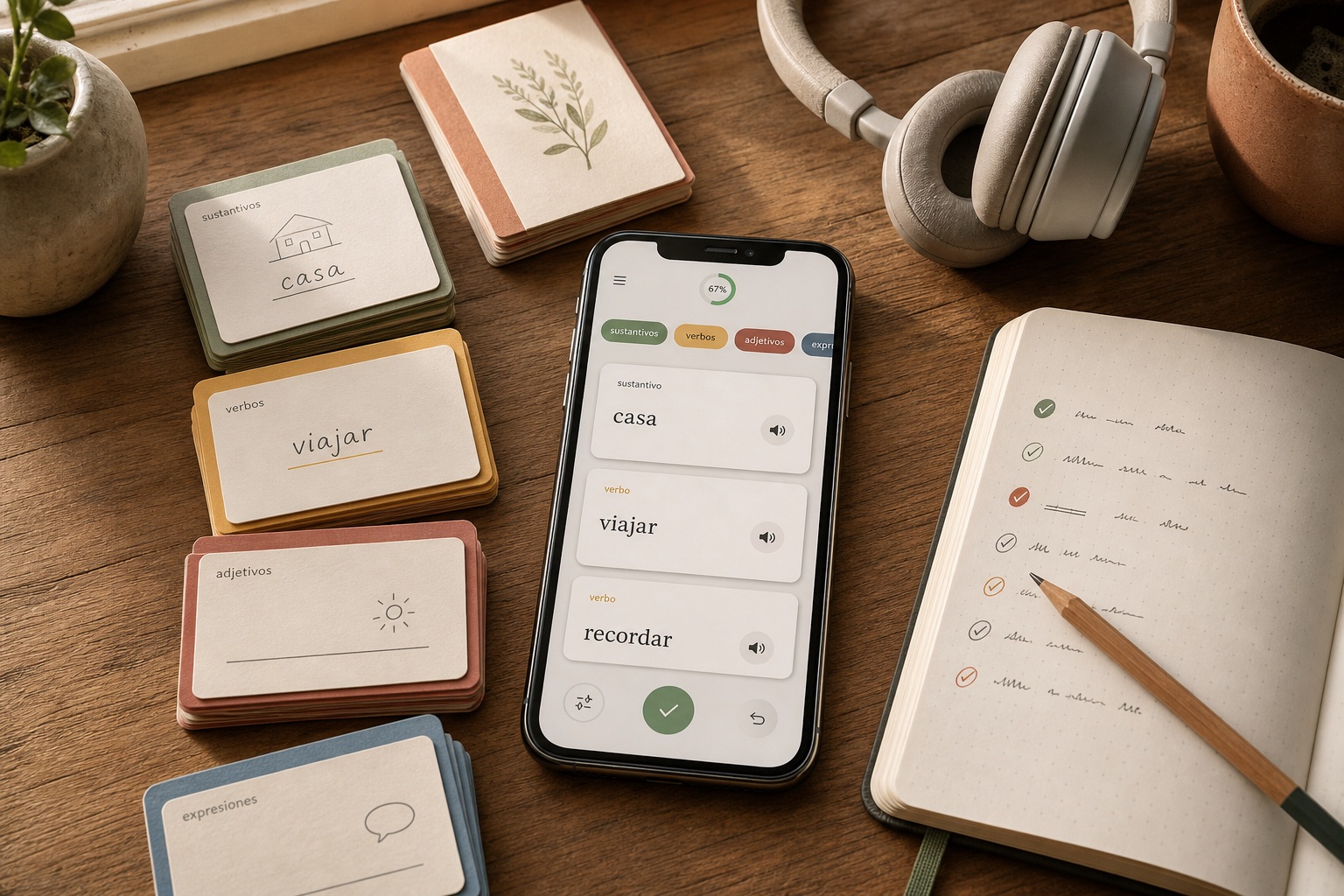
Rather than relying on automated size estimators, maintain a five-column notebook tracking lemma, context, recognize, retrieve, and use. For instance, log the lemma llegar with the context el tren llega temprano. Mark whether you recognize it in text (yes), retrieve it unprompted (partial), and use it spontaneously in speech (not yet).
As an optional and manageable habit, choose five useful terms from daily input to log in your notebook. Selecting five terms is an approachable personal guideline rather than an optimal dose or fluency guarantee, keeping study consistent while targeting words relevant to you.
Research Sources and References
This article references academic corpus linguistics and European language framework documentation:
Frequently Asked Questions
Can I be fluent in Spanish with 1,000 words?
No specific threshold guarantees fluency, and 1,000 lemmas cannot be considered universally sufficient for survival or basic communication. Vocabulary adequacy depends on the specific communicative task, context, and measurement unit, while conversational fluency also requires complex grammar and listening automaticity.
Do 3,000 lemmas guarantee 94% comprehension?
No. In Mark Davies's (2005) oral corpus sample, 3,000 lemmas accounted for 94.0% of running tokens, but token coverage does not guarantee comprehension. Within that corpus, missing tokens can carry critical semantic meaning essential for understanding.
What differentiates a lemma from a word family?
A lemma groups grammatical inflections of one headword, like hablar and hablo. A word family includes derived words like hablante, which require independent learning.
Why does recognizing a word differ from using it?
Receptive recognition relies on reading or listening context. Spontaneous use requires unprompted recall, accurate conjugation, correct pronunciation, and real-time execution in conversation.
Study Sentence Library
Copy these study sentences to your notebook for optional offline practice. These examples are separate from the prebuilt audio vocabulary cards in the app.
**Optional Written Sentences**

El profesor abre la puerta. - The teacher opens the door.
Nosotros abrimos las ventanas hoy. - We open the windows today.
La apertura de la tienda fue ayer. - The store opening was yesterday.
Mi amigo ha abierto el libro. - My friend has opened the book.
Ella lee un libro en casa. - She reads a book at home.
Mi amigo escribe una carta breve. - My friend writes a short letter.
No tenemos tiempo para leer. - We do not have time to read.
Ellos buscan una casa nueva. - They are looking for a new house.
Siempre uso palabras sencillas con amigos. - I always use simple words with friends.
Conversamos sobre la lección en clase. - We chat about the lesson in class.
Ella comparte palabras amables con todos. - She shares kind words with everyone.
Escribo mensajes claros para mi equipo. - I write clear messages for my team.
Explore Focused Word Practice
Conversational ability requires balancing reading, listening, and speaking. For optional word practice with prebuilt pronunciation audio, explore Hola Cards on mobile as an offline guest or on the web.