Spanish weather vocabulary
What Spanish weather vocabulary should a beginner learn first?
Begin with the question ¿Qué tiempo hace? and a small set of high-frequency answers: Hace sol, Hace calor, Hace frío, Está nublado, Llueve, and Hay niebla. These patterns let you understand a basic forecast, decide what to wear, and start a simple conversation.
Keep el tiempo and el clima separate. El tiempo describes current or short-term weather; el clima describes the usual conditions of a place over time. Learn nouns with their articles, but store complete expressions such as hace viento and está nevando as single cards.
Choose hacer, estar, hay, or a weather verb
Use hacer for the general feel of the weather: hace calor, hace frío, hace fresco, hace sol, and hace viento. Use estar for a current state: está nublado, está despejado, está lloviendo, and está nevando.
Use hay before a weather noun when you mean there is or there are: Hay niebla and Hay hielo en la carretera. Llover and nevar also work on their own: Llueve and Nieva. For a near forecast, va a + infinitive is useful: Mañana va a llover.
40 essential Spanish weather words and phrases with examples
Each row gives the Spanish item, a natural translation, one short example, and a note on the pattern to remember.
| Spanish | Translation | Example | Beginner note |
|---|---|---|---|
| el tiempo | the weather | ¿Qué tiempo hace hoy? | Tiempo is current weather; clima is the longer-term pattern. |
| el clima | the climate | El clima aquí es seco. | Tiempo is current weather; clima is the longer-term pattern. |
| la temperatura | the temperature | La temperatura baja por la noche. | Use it with subir, bajar, máxima, and mínima. |
| el grado | the degree | Hace veinte grados. | Use a number plus grados; weather commonly uses hacer. |
| el pronóstico del tiempo / la previsión del tiempo | the weather forecast | Miro el pronóstico antes de salir. | Pronóstico is broad; previsión del tiempo is especially common in Spain. |
| el cielo | the sky | El cielo está gris. | Learn this weather noun with its article. |
| el sol | the sun | Hoy brilla el sol. | Learn this weather noun with its article. |
| la nube | the cloud | Esa nube es oscura. | Learn this weather noun with its article. |
| hace sol | it is sunny | Hoy hace sol. | Memorise the complete impersonal expression with hace. |
| hace calor | it is hot | En agosto hace calor. | Memorise the complete impersonal expression with hace. |
| hace frío | it is cold | Esta mañana hace frío. | Memorise the complete impersonal expression with hace. |
| hace fresco | it is cool | Por la noche hace fresco. | Memorise the complete impersonal expression with hace. |
| hace buen tiempo | the weather is nice | Hoy hace buen tiempo. | A common fixed phrase for generally good or bad weather. |
| hace mal tiempo | the weather is bad | Hoy hace mal tiempo. | A common fixed phrase for generally good or bad weather. |
| está despejado | it is clear | Esta tarde está despejado. | Estar describes the current state or an action in progress. |
| está nublado | it is cloudy | Ahora está nublado. | Estar describes the current state or an action in progress. |
| la lluvia | the rain | La lluvia empieza a las seis. | Learn this weather noun with its article. |
| llueve | it rains; it is raining | Llueve mucho en abril. | An impersonal weather verb; no subject is needed. |
| la llovizna | the drizzle | Hay una llovizna ligera. | Learn this weather noun with its article. |
| está lloviendo | it is raining | Está lloviendo ahora. | Highlights what is happening right now. |
| la tormenta | the storm | Se acerca una tormenta. | Useful for forecasts, warnings, and travel plans. |
| el trueno | the thunder | Oigo un trueno. | Keep thunder and lightning as a contrasting pair. |
| el rayo | the lightning bolt | Cayó un rayo cerca. | Keep thunder and lightning as a contrasting pair. |
| el arcoíris | the rainbow | Después de la lluvia salió un arcoíris. | A single word; the plural is arcoíris too. |
| el viento | the wind | El viento sopla del norte. | Learn this weather noun with its article. |
| hace viento | it is windy | Hoy hace mucho viento. | Memorise the complete impersonal expression with hace. |
| la nieve | the snow | La nieve cubre la calle. | Learn this weather noun with its article. |
| nieva | it snows; it is snowing | En la montaña nieva. | An impersonal weather verb; no subject is needed. |
| está nevando | it is snowing | Está nevando ahora. | Highlights what is happening right now. |
| el hielo | the ice | Hay hielo en la carretera. | Learn this weather noun with its article. |
| la helada | the frost | Hubo una helada anoche. | Learn this weather noun with its article. |
| el granizo | the hail | El granizo golpea la ventana. | Useful for forecasts, warnings, and travel plans. |
| la niebla | the fog | La niebla cubre el puente. | Learn this weather noun with its article. |
| hay niebla | it is foggy | Hay niebla esta mañana. | Use hay + noun when the condition is present. |
| la primavera | spring | La primavera empieza en marzo. | A season name; learn it with its article. |
| el verano | summer | En verano hace calor. | A season name; learn it with its article. |
| el otoño | autumn; fall | En otoño llueve más. | A season name; learn it with its article. |
| el invierno | winter | En invierno puede nevar. | A season name; learn it with its article. |
| ¿Qué tiempo hace? | What is the weather like? | ¿Qué tiempo hace en Madrid? | A ready-made question for current conditions. |
| ¿Cuántos grados hace? | What is the temperature? | ¿Cuántos grados hace fuera? | A ready-made question for current conditions. |
Study Spanish weather vocabulary in five groups
Eight items per group turn a mixed forecast into a predictable study route.
Weather basics
Core nouns for weather, climate, temperature, forecasts, sky, sun, and clouds.
el tiempo · el clima · la temperatura · el grado · el pronóstico del tiempo / la previsión del tiempo · el cielo · el sol · la nube
Everyday conditions
Eight complete expressions with hacer and estar for common daily weather.
hace sol · hace calor · hace frío · hace fresco · hace buen tiempo · hace mal tiempo · está despejado · está nublado
Rain and storms
Rain nouns, weather verbs, an action in progress, thunder, lightning, and a rainbow.
la lluvia · llueve · la llovizna · está lloviendo · la tormenta · el trueno · el rayo · el arcoíris
Wind, snow, and ice
Wind expressions plus snow, ice, frost, and hail for cold forecasts.
el viento · hace viento · la nieve · nieva · está nevando · el hielo · la helada · el granizo
Fog, seasons, and questions
Two fog patterns, four seasons, and two questions for real conversations.
la niebla · hay niebla · la primavera · el verano · el otoño · el invierno · ¿Qué tiempo hace? · ¿Cuántos grados hace?
Build natural weather sentences and simple forecasts
Treat expressions with hacer as fixed chunks rather than translating word by word. Hace veinte grados means it is twenty degrees, while Hace mucho viento means it is very windy.
Use estar when the sky or an event is in progress: El cielo está despejado, Está lloviendo, Está nevando. Use hay with visible conditions or hazards: Hay niebla, Hay hielo, Hay una tormenta.
For tomorrow, combine a time word with ir a: Mañana va a llover or Esta noche va a nevar. Forecasts also use habrá, but the beginner-friendly hay and va a patterns cover many practical situations.
Hola Cards is a Spanish flashcard app from holacards.org for iOS and Android. It is free to download, requires no account, may show ads in the free version, while Premium removes ads, works offline, offers an interface available in 29 languages, including English, Russian, Portuguese and German, and supports card translations in 29 languages, including English, Russian, Portuguese and German. Learners can practise weather vocabulary with audio, writing, pronunciation, custom groups, spaced review, and 18 practice and game modes.
Connect weather with hacer phrases, hay and está, numbers and degrees, travel planning, and pronunciation.
Hacer phrases for beginners Hay vs está in Spanish Spanish numbers, dates, and time Spanish travel phrases Spanish pronunciation for beginners

How to learn the 40 weather items in five steps
- Choose one eight-item group and read every Spanish word or phrase aloud.
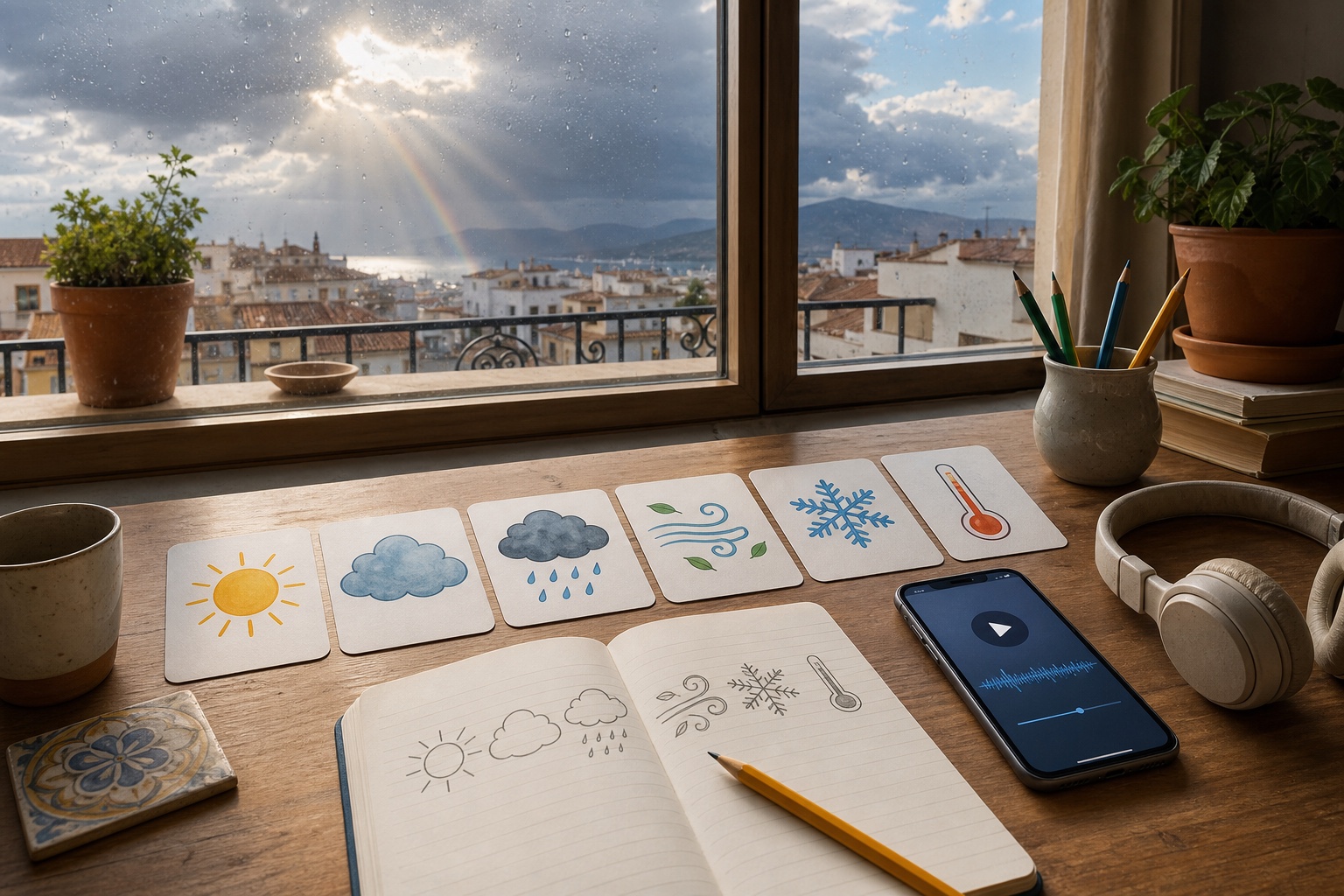
- Match each card to the sky outside, a weather photo, or a forecast icon.
- Sort full expressions by hacer, estar, hay, llover, or nevar.
- Say one sentence about today and one short forecast for tomorrow.
- Review the complete 40-item group in Hola Cards with audio, writing, pronunciation, and spaced repetition.
FAQ
How do you ask what the weather is like in Spanish?
Ask ¿Qué tiempo hace? for current weather. You can add hoy or a place: ¿Qué tiempo hace hoy? ¿Qué tiempo hace en Madrid? For tomorrow, ask ¿Qué tiempo va a hacer mañana?
What is the difference between tiempo and clima?
El tiempo is the weather now or over a short period. El clima is the usual long-term pattern of a place, such as a dry or tropical climate.
Why do some weather phrases use hace and others use está?
Hacer describes the general feel or condition: hace frío, hace sol, hace viento. Estar describes a current state or action in progress: está nublado, está lloviendo.
What is the difference between llueve and está lloviendo?
Llueve states that it rains or is raining. Está lloviendo emphasises that the rain is happening right now. Both can describe current rain.
Copy all 40 Spanish weather items into Hola Cards
Open word groups in Hola Cards, choose paste/import, and paste this block. The app can read the title and the “Spanish - translation” lines.
**Spanish weather: 40 words and phrases**

el tiempo - the weather
el clima - the climate
la temperatura - the temperature
el grado - the degree
el pronóstico del tiempo / la previsión del tiempo - the weather forecast
el cielo - the sky
el sol - the sun
la nube - the cloud
hace sol - it is sunny
hace calor - it is hot
hace frío - it is cold
hace fresco - it is cool
hace buen tiempo - the weather is nice
hace mal tiempo - the weather is bad
está despejado - it is clear
está nublado - it is cloudy
la lluvia - the rain
llueve - it rains; it is raining
la llovizna - the drizzle
está lloviendo - it is raining
la tormenta - the storm
el trueno - the thunder
el rayo - the lightning bolt
el arcoíris - the rainbow
el viento - the wind
hace viento - it is windy
la nieve - the snow
nieva - it snows; it is snowing
está nevando - it is snowing
el hielo - the ice
la helada - the frost
el granizo - the hail
la niebla - the fog
hay niebla - it is foggy
la primavera - spring
el verano - summer
el otoño - autumn; fall
el invierno - winter
¿Qué tiempo hace? - What is the weather like?
¿Cuántos grados hace? - What is the temperature?
Practise Spanish weather vocabulary in Hola Cards
Hola Cards turns these 40 words and phrases into flashcards with audio, writing, pronunciation practice, custom groups, and spaced review on iOS and Android.