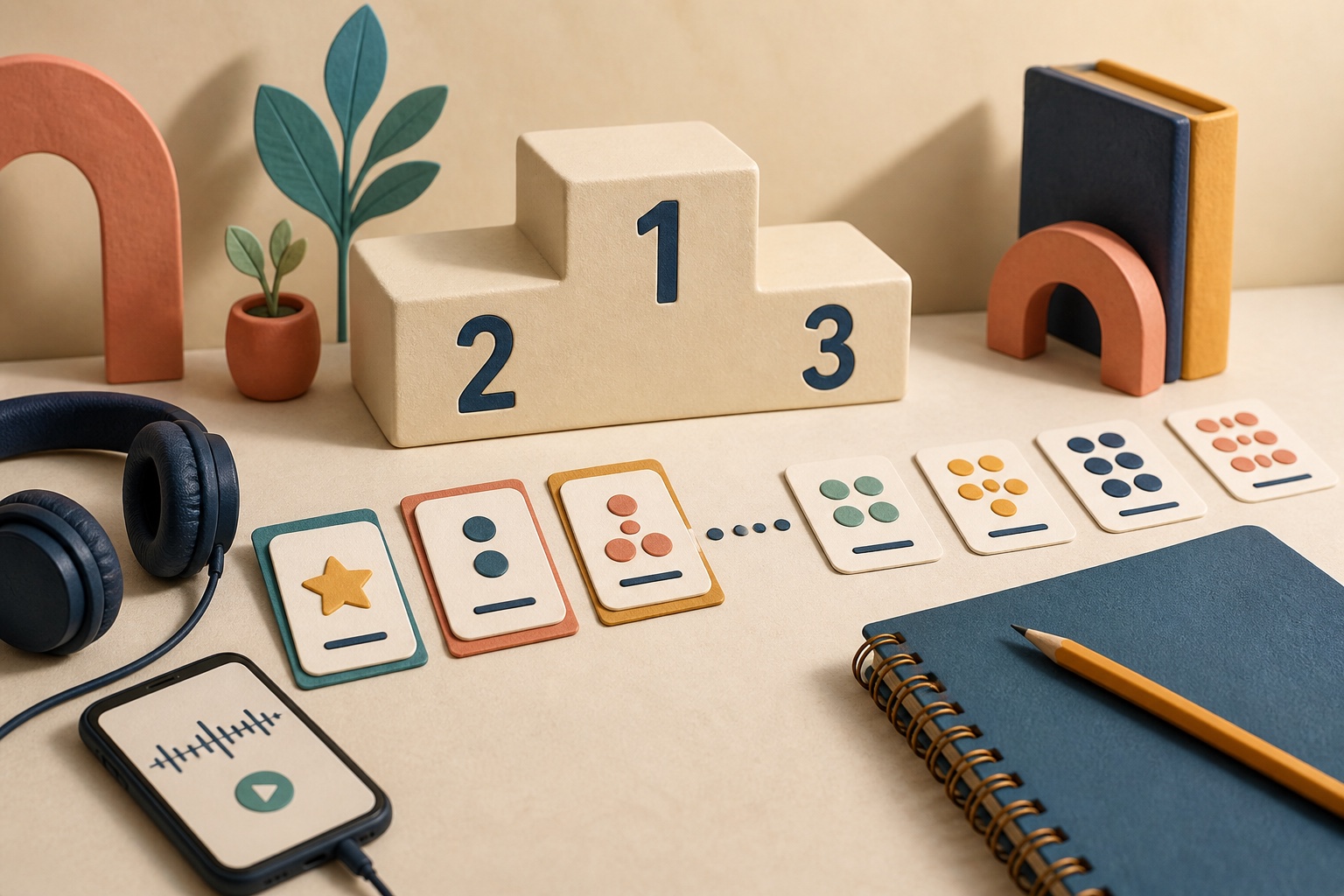
Practise ordinal numbers inside useful phrases
Import the 20 forms and recall them with Spanish audio and writing on iOS or Android. This guide remains complete without the app.
ordinal numbers in Spanish
How do Spanish ordinal numbers work?
Use an ordinal to identify position in a sequence: la segunda lección, el cuarto intento, el vigésimo aniversario. In ordinary noun phrases, the ordinal normally comes before the noun.
Match gender and number: primero, primera, primeros, primeras. Primero becomes primer and tercero becomes tercer only before a masculine singular noun: el primer capítulo, el tercer día.
Abbreviations keep a full stop before the superscript indicator: 1.º, 1.ª and 3.er. For 11th and 12th, undécimo and duodécimo coexist with decimoprimero / décimo primero and decimosegundo / décimo segundo.
Choose the right form in four checks
Identify the position, then choose the ordinal instead of the cardinal: el segundo capítulo, not el dos capítulo.
Match the noun in gender and number: la cuarta página, los primeros días.
Use primer and tercer immediately before a masculine singular noun; keep primero and tercero elsewhere.
For 11th–19th, learn one accepted form consistently and recognise the alternatives. In careful writing, keep the accent shown in decimoséptimo.
Spanish ordinal numbers from 1st to 20th
The table gives the beginner forms, a natural example and the rule that matters most for each item.
| Ordinal in Spanish | Meaning | Example in context | Form note |
|---|---|---|---|
| primero / primera | first | Vivo en el primer piso. | Primero shortens to primer before a masculine singular noun. |
| segundo / segunda | second | Esta es la segunda lección. | The ordinal agrees with the noun in gender and number. |
| tercero / tercera | third | Lee el tercer capítulo. | Tercero shortens to tercer before a masculine singular noun. |
| cuarto / cuarta | fourth | Es mi cuarto intento. | The ordinal agrees with the noun in gender and number. |
| quinto / quinta | fifth | Llegó en quinta posición. | The ordinal agrees with the noun in gender and number. |
| sexto / sexta | sixth | La oficina está en la sexta planta. | The ordinal agrees with the noun in gender and number. |
| séptimo / séptima | seventh | Hoy es el séptimo día. | Keep the written accent. |
| octavo / octava | eighth | Abre la octava página. | The ordinal agrees with the noun in gender and number. |
| noveno / novena | ninth | Terminó en noveno lugar. | The ordinal agrees with the noun in gender and number. |
| décimo / décima | tenth | Es la décima pregunta. | Keep the written accent. |
| undécimo / decimoprimero / décimo primero | eleventh | Vive en el undécimo piso. | Undécimo, decimoprimero and décimo primero are accepted. |
| duodécimo / decimosegundo / décimo segundo | twelfth | Es el duodécimo capítulo. | Duodécimo, decimosegundo and décimo segundo are accepted. |
| decimotercero / décimo tercero | thirteenth | Llegó en decimotercera posición. | A joined or two-word compound form is accepted. |
| decimocuarto / décimo cuarto | fourteenth | Es su decimocuarto cumpleaños. | A joined or two-word compound form is accepted. |
| decimoquinto / décimo quinto | fifteenth | Lee la decimoquinta página. | A joined or two-word compound form is accepted. |
| decimosexto / décimo sexto | sixteenth | Es la decimosexta lección. | A joined or two-word compound form is accepted. |
| decimoséptimo / décimo séptimo | seventeenth | Terminó en decimoséptimo lugar. | Keep the written accent. |
| decimoctavo / décimo octavo | eighteenth | Celebran el decimoctavo aniversario. | A joined or two-word compound form is accepted. |
| decimonoveno / décimo noveno | nineteenth | Es la decimonovena edición. | A joined or two-word compound form is accepted. |
| vigésimo / vigésima | twentieth | Hoy empieza el vigésimo curso. | Vigésimo is the base form for twentieth. |
Learn the sequence in four short blocks
Build a stable 1–10 base, then add the accepted compound patterns through twentieth.
First to fifth
Start with the three highest-frequency forms and add cuarto and quinto.
primero / primera · segundo / segunda · tercero / tercera · cuarto / cuarta · quinto / quinta
Sixth to tenth
Complete the simple 1–10 base and protect the accent in séptimo and décimo.
sexto / sexta · séptimo / séptima · octavo / octava · noveno / novena · décimo / décima
Eleventh to fifteenth
Recognise the special 11th and 12th forms, then build compounds.
undécimo / decimoprimero / décimo primero · duodécimo / decimosegundo / décimo segundo · decimotercero / décimo tercero · decimocuarto / décimo cuarto · decimoquinto / décimo quinto
Sixteenth to twentieth
Finish the joined or two-word compounds and learn vigésimo.
decimosexto / décimo sexto · decimoséptimo / décimo séptimo · decimoctavo / décimo octavo · decimonoveno / décimo noveno · vigésimo / vigésima
Common mistakes to avoid
Do not use an ordinal for most calendar dates: Spanish normally says el cinco de mayo, not el quinto de mayo. Primero is possible for the first day of a month.
Do not omit agreement: la primera vez, el segundo libro, las terceras personas.
Write 1.º or 1.ª with a full stop before the raised letter. The masculine apocopated forms may be abbreviated 1.er and 3.er.
In everyday speech, high ordinals are less common than cardinals in many contexts. This page focuses on the forms beginners genuinely meet.
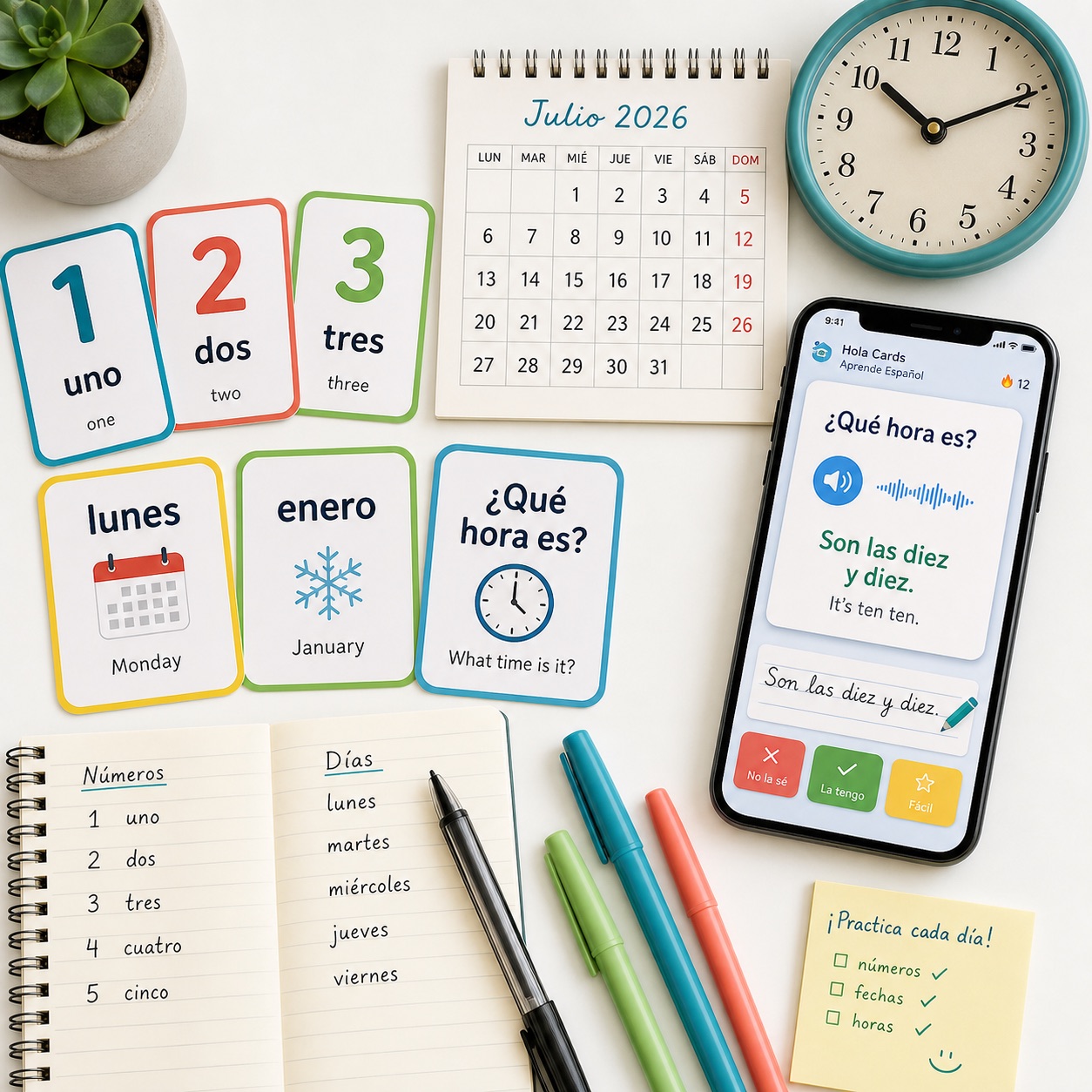
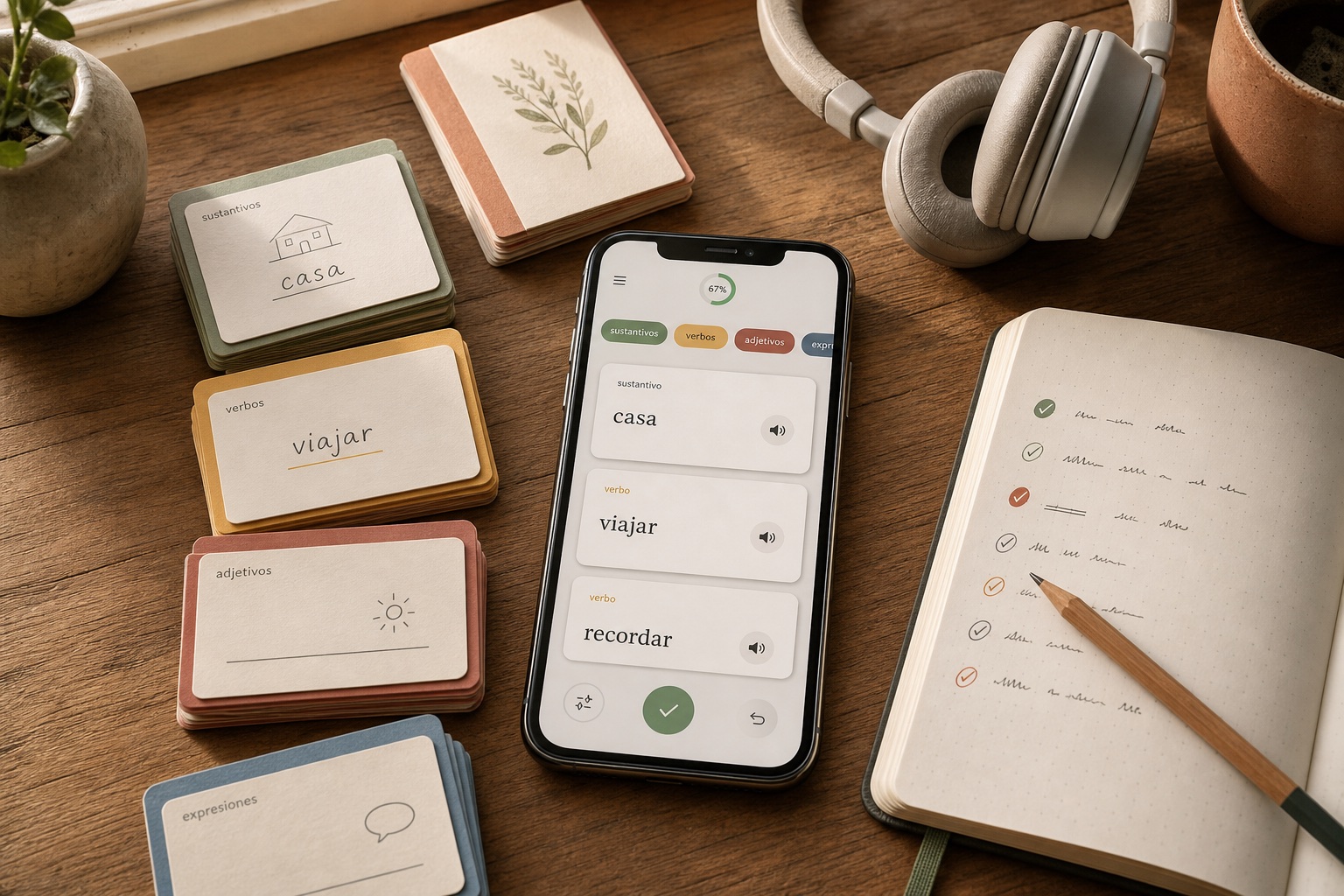
Hola Cards is a Spanish flashcard app from holacards.org for iOS and Android. It is free to download, requires no account, may show ads in the free version, while Premium removes ads, and works offline. The interface is available in 29 languages, including English, Russian, Portuguese and German; cards support translations in 29 languages, including English, Russian, Portuguese and German and 18 practice and game modes. The starter Numbers group includes primero, segundo, and tercero, and you can import all 20 forms below into a custom group for Spanish audio, writing, pronunciation, and spaced review. Hola Cards does not choose ordinal agreement or abbreviations automatically, so verify each form with the rule and noun.
Connect ordinal order with cardinal numbers, dates, articles, adjective agreement and city locations.
Numbers, dates and time Definite and indefinite articles Adjective agreement Places in the city Prepositions of place
A five-minute ordinal routine
- Say primero through décimo in order.
- Attach each form to one noun and change two examples to feminine.
- Practise el primer día and el tercer piso beside primero and tercero.
- Add undécimo through vigésimo in two groups of five.
- Write 1.º, 1.ª, 1.er and 3.er once, including the full stop.
Primary grammar and spelling references
Forms, variants, abbreviations and A1–A2 scope were checked against RAE–ASALE and Instituto Cervantes.
- RAE–ASALE: cardinal and ordinal numeral forms
- RAE–ASALE: writing and using numerals
- Instituto Cervantes: A1–A2 grammar inventory
FAQ
What are the first ten ordinal numbers in Spanish?
Primero, segundo, tercero, cuarto, quinto, sexto, séptimo, octavo, noveno and décimo.
Why do primero and tercero become primer and tercer?
They shorten immediately before a masculine singular noun: el primer día and el tercer piso.
Do Spanish ordinal numbers agree with nouns?
Yes. Use forms such as primera, segundos and terceras to match gender and number.
How do you abbreviate first in Spanish?
Use 1.º for masculine, 1.ª for feminine and 1.er before a masculine singular noun. Keep the full stop before the raised indicator.
Is eleventh undécimo or decimoprimero?
Both are accepted; décimo primero is also possible. Choose one form consistently and recognise the alternatives.
Does Hola Cards choose the ordinal form automatically?
No. You can import and practise these fixed forms; this page explains agreement, shortening and abbreviations.
Copy the 20 ordinal forms to Hola Cards
Open word groups in Hola Cards, choose paste/import, and paste the block. The app recognises the title and “Spanish - translation” lines.
**Spanish ordinal numbers: 1st–20th**

primero / primera - first
segundo / segunda - second
tercero / tercera - third
cuarto / cuarta - fourth
quinto / quinta - fifth
sexto / sexta - sixth
séptimo / séptima - seventh
octavo / octava - eighth
noveno / novena - ninth
décimo / décima - tenth
undécimo / decimoprimero / décimo primero - eleventh
duodécimo / decimosegundo / décimo segundo - twelfth
decimotercero / décimo tercero - thirteenth
decimocuarto / décimo cuarto - fourteenth
decimoquinto / décimo quinto - fifteenth
decimosexto / décimo sexto - sixteenth
decimoséptimo / décimo séptimo - seventeenth
decimoctavo / décimo octavo - eighteenth
decimonoveno / décimo noveno - nineteenth
vigésimo / vigésima - twentieth
Review Spanish ordinal numbers in Hola Cards
Practise the 20 forms with Spanish audio, writing, pronunciation, custom groups, and spaced review on iOS and Android.