Short answer: define the boundary before choosing an app
If your goal is to avoid generative AI, check what creates the lesson and what judges your answer. A fixed vocabulary card, a multiple-choice exercise and a known correct spelling are deterministic. A chatbot that invents dialogue, rewrites your answer or generates a lesson from a prompt is generative.
Speech recognition needs a separate question. It may use a local acoustic model to turn your voice into text without acting as a tutor or composing feedback. Decide whether you want to avoid all machine-learning models or specifically generative content; those are different requirements.
The honest label for Hola Cards is “without generative-AI lessons or chatbot tutoring”, not “uses no AI or machine learning of any kind”. Its optional pronunciation checks use a downloadable Vosk speech-recognition model on the device.
Six checks that make a “no generative AI” claim useful
| Check | Why it matters | What a clear answer looks like |
|---|---|---|
| Lesson source | Generated lessons can vary between sessions | A fixed, reviewable catalogue or named human-authored source |
| Feedback boundary | Open-ended corrections may be invented or inconsistent | Known answers, spelling checks or clearly limited speech matching |
| Chatbot role | A conversational agent changes both method and data flow | No chatbot, or an explicit opt-in rather than a hidden default |
| Speech recognition | Voice matching may use ML without being generative | The app names the model, whether it is local and what it checks |
| Offline behaviour | A real offline path reduces dependence on cloud generation | Cards and core exercises still open in airplane mode |
| Learning scope | Removing AI does not make an app a complete course | The app says whether it teaches vocabulary, grammar, listening or conversation |
A no-chatbot Spanish routine you can use anywhere
You do not need generated lessons to make a useful 12-minute session. Choose eight words from one real task, such as ordering food or asking for directions, and keep the correct answers visible in a trusted source.
- Minutes 1–3: read and listen to the eight words, marking stress and one pronunciation trap.
- Minutes 4–6: cover the Spanish side and retrieve each word from its meaning.
- Minutes 7–9: write the missed words and one short sentence with each of the two hardest items.
- Minutes 10–11: say the words and sentences aloud, comparing them with the reference audio.
- Minute 12: keep only the mistakes for tomorrow before adding new material.
This loop is predictable and inspectable: the material, answer and correction rule are known before the session begins. A teacher or native speaker is still the better choice for nuanced conversation and free-form writing feedback.
How Hola Cards fits this definition
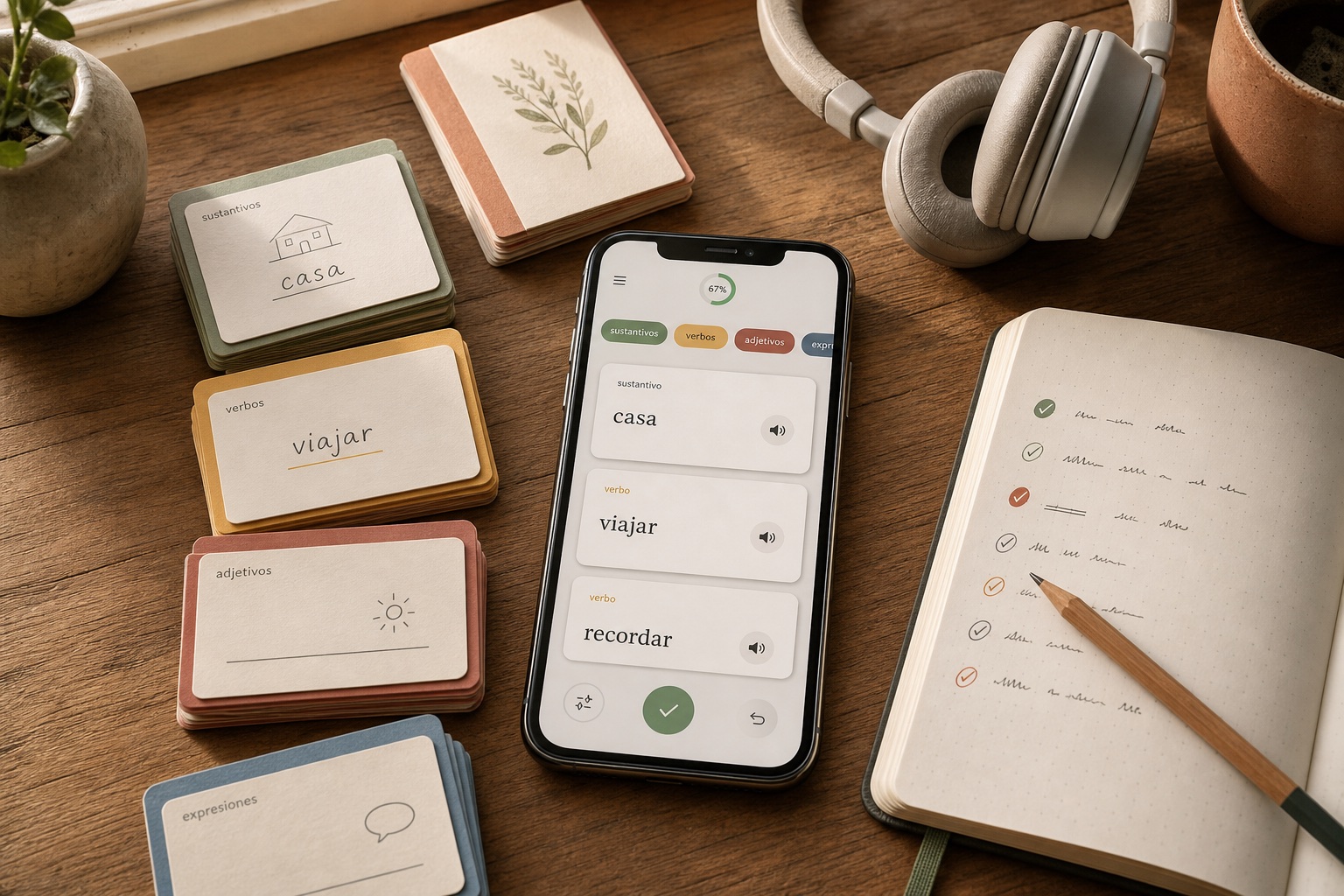
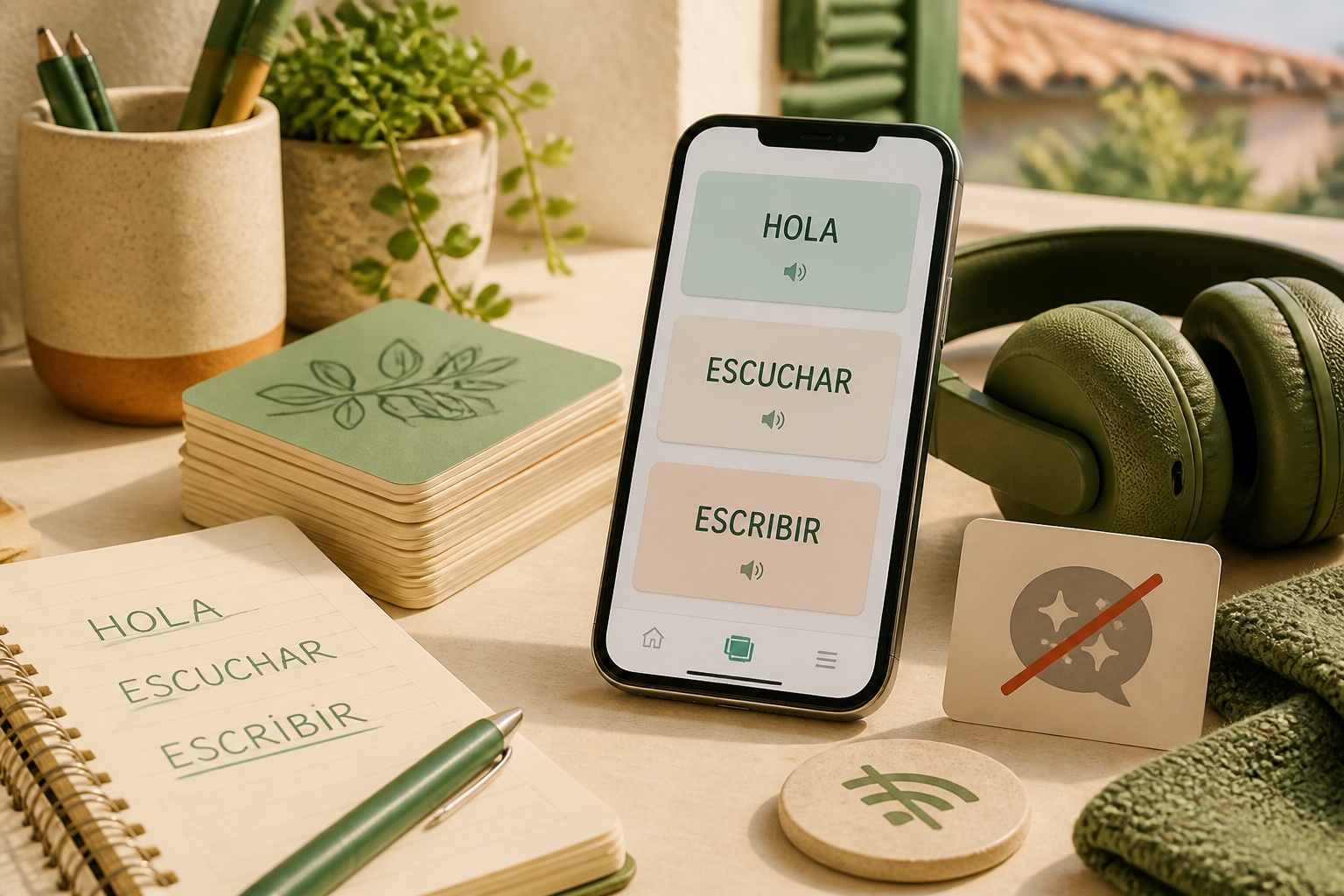
Hola Cards is a Spanish vocabulary and flashcard app for iPhone, iPad and Android. It does not include a generative chatbot, AI-written lessons or open-ended AI correction. Its cards, translations, examples and game prompts come from a fixed catalogue and fixed exercise logic.
The app includes more than 2,300 word and verb-form cards, card translations in 29 languages, including English, Russian, Portuguese and German and 18 practice and game modes. You can listen, recall, write and practise pronunciation; the interface is available in 29 languages, including English, Russian, Portuguese and German.
Cards and core practice work offline. Pronunciation modes use a downloadable Vosk speech-recognition model locally to compare recognised speech with the expected answer. That is machine learning, but it does not generate a conversation, lesson or essay correction.
Hola Cards is free to download, requires no account and may show ads in the free version, while Premium removes ads. The catalogue no longer has the former 200-word limit. Mobile Premium removes ads and opens additional tools such as word editing, group management, listening and the live translator. The store displays the current regional price.
The optional live translator is a separate online workflow: it translates newly recognized text rather than selecting an answer from the fixed catalogue. The description of non-generative flashcard exercises should not be read as a claim about every service in the app.
Limits: Hola Cards is not a structured grammar course, an AI conversation partner or a service for correcting essays. It also does not schedule reviews with FSRS or SM-2 due dates. Choose a teacher, exchange partner or specialist tool when you need free conversation or detailed writing feedback.
Who should choose a fixed-content app
A fixed-content app is a good fit when you want repeatable vocabulary practice, transparent right and wrong answers, offline access and no chatbot in the learning loop. It is also easier to audit: you can inspect the card and decide whether the translation or example deserves a place in your active vocabulary.
It is a weaker fit when your main goal is unscripted conversation, personalised explanations or feedback on long writing. Avoid treating “no generative AI” as a quality certificate by itself. Check the content, practice design and honest limitations as carefully as the technology label.
Questions about Spanish apps without generative AI
Does Hola Cards use generative AI?
No generative chatbot, AI-written lesson or open-ended AI correction is part of Hola Cards. Cards and exercises are fixed. Pronunciation practice uses a downloadable local Vosk speech-recognition model, which is machine learning but not generative AI.
Is speech recognition the same as generative AI?
No. Speech recognition converts audio into recognised words. Generative AI creates new text, audio or other content. Both may use machine-learning models, so an app should state which one it uses and for what purpose.
Can I learn Spanish without an AI tutor?
Yes. A small set of trusted words, reference audio, active recall, writing and regular correction of mistakes can build vocabulary without a chatbot. Human feedback is more useful than generated feedback for nuanced conversation and long writing.
Does Hola Cards work offline?
Cards and core practice work offline. Pronunciation checks use a speech model downloaded to the device. The initial app, model or catalogue update still requires a connection.
Is Hola Cards a complete Spanish course?
No. It is a vocabulary, flashcard and practice app. It does not replace a structured grammar course, conversation partner or teacher.