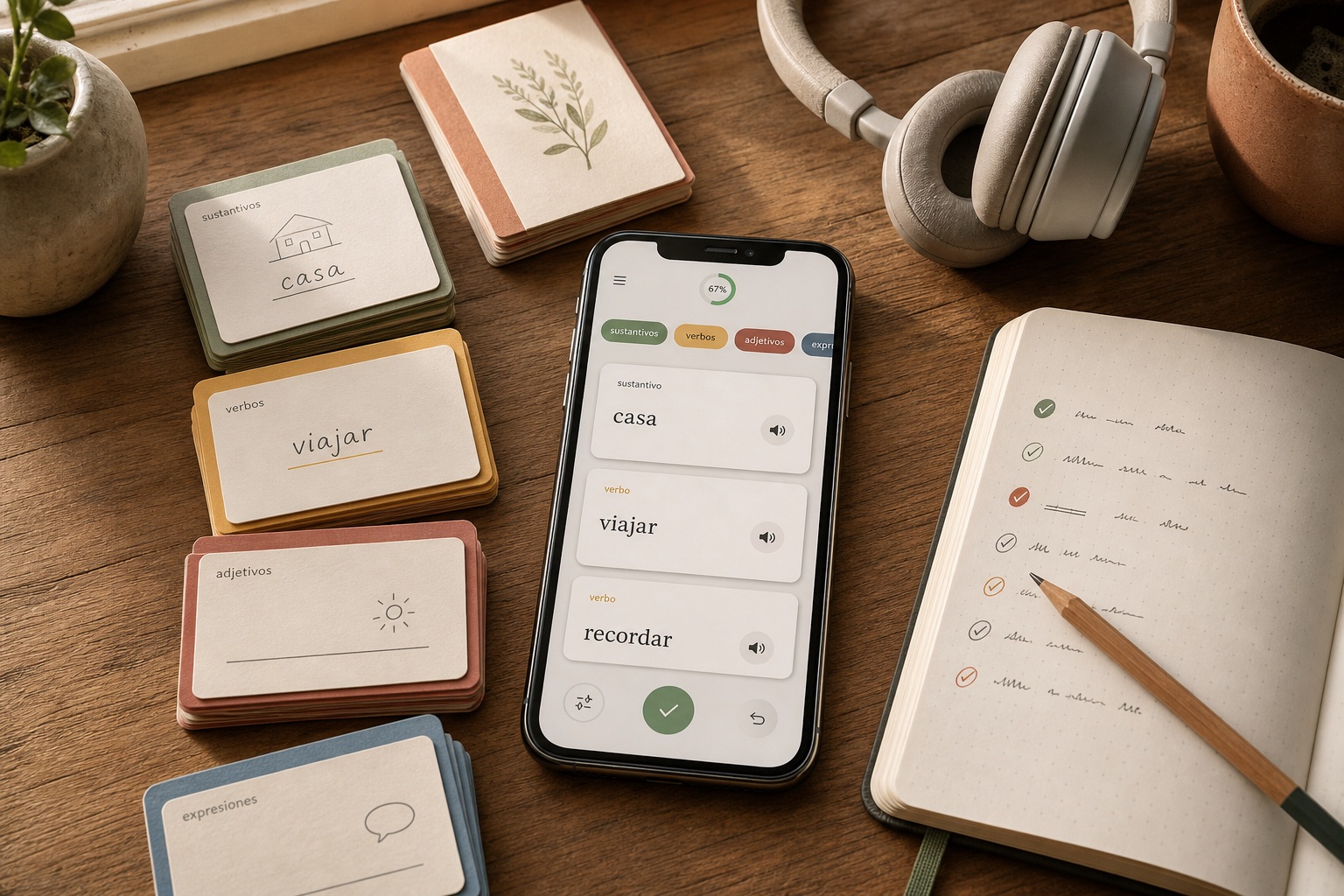
Practice Literal Meanings in Hola Cards
Study the literal definitions of these twelve phrases in Hola Cards. Word-level review reinforces spelling and vocabulary, while contextual interpretation remains an offline observation skill.
Spanish irony and sarcasm examples
Why Context Shapes Spanish Irony
In Spanish, the same utterance can be sincere or ironic depending on context, shared expectations, relationships, and delivery. Tone provides no reliable formula, and no expression or intonation reliably diagnoses irony. For B1–B2 learners, interpreting indirect meaning requires noticing contextual mismatches rather than memorizing insults or fillers.
Irony often conveys playful, self-directed humor offering a different perspective, whereas sarcasm commonly introduces harsher mockery. Because these categories overlap without rigid boundaries, learners should evaluate situational evidence rather than assuming a smile or deadpan tone confirms intent.
Everyday Task and Environment Micro-Scenes
In this original illustrative example, not from recorded speech, a colleague opens an organized spreadsheet and notes: Está clarísimo. Sincere context: The speaker confirms the report is lucid. Possible ironic context: If the attached spreadsheet arrives empty and corrupted, saying Está clarísimo creates a contextual mismatch, likely mocking the missing file. Sarcasm here targets the situation rather than attacking a person, though flat delivery alone never proves mockery over weary self-directed fatigue.
In another original illustrative example, colleagues inspect an ample meeting room and comment: Hay muchísimo espacio. Sincere context: The statement affirms adequate room. Possible ironic context: When four people squeeze into a broom closet, uttering Hay muchísimo espacio clashes with reality. This playful irony underscores crowding, though in tense relationships it can sting as biting sarcasm toward poor planning. Punctuation or a smiling emoji in text cannot confirm playful intent over sharp irritation.
Everyday Ambiguous Expressions and Clarification Phrases
Study the baseline literal meanings of these common expressions before analyzing their contextual use in conversation.
| Spanish | Literal meaning |
|---|---|
| Qué gran ayuda | What great help |
| Está clarísimo | It is very clear |
| Buen trabajo | Good work |
| Llegó a tiempo | It arrived on time |
| Hay muchísimo espacio | There is plenty of space |
| Qué maravilla | What a wonder |
| No me digas | Do not tell me |
| Perfecto | Perfect |
| ¿Lo dices en broma o en serio? | Are you saying it as a joke or seriously? |
| ¿A qué te refieres exactamente? | What do you mean exactly? |
| No estoy seguro de haberte entendido bien | I am not sure I understood you correctly |
| Prefiero confirmar para no malinterpretarte | I prefer to confirm so as not to misunderstand you |
Three Practical Principles for Interpreting Irony
Apply these three core principles when observing indirect speech in Spanish:
Establish Literal Foundations
Master exact literal definitions and pronunciations first so you recognize when real-world facts diverge from spoken words.
Qué gran ayuda · Está clarísimo · Buen trabajo · Llegó a tiempo
Notice Contextual Mismatches
Observe visible discrepancies between physical reality and literal statements rather than relying solely on vocal tone or facial expressions.
Hay muchísimo espacio · Qué maravilla · No me digas · Perfecto
Clarify with Neutral Questions
Use nonaccusatory questions to verify intended meaning whenever ambiguity threatens mutual understanding in daily conversation.
¿Lo dices en broma o en serio? · ¿A qué te refieres exactamente? · No estoy seguro de haberte entendido bien · Prefiero confirmar para no malinterpretarte
Contrasting Effort, Timelines, and Expressive Edge
This third original illustrative example contrasts cooperation with broken promises. A neighbor helps carry three heavy boxes upstairs, prompting: Qué gran ayuda. Sincere context: The speaker expresses genuine gratitude. Possible ironic context: If a roommate promised moving assistance but plays video games while others carry furniture, uttering Qué gran ayuda highlights unfulfilled expectations. The mismatch makes sarcasm probable, carrying a sharper critical sting, though vocal inflection alone cannot distinguish hostile criticism from private humor without knowing their history.
Our fourth original illustrative example examines timing. A courier delivers a report right before a meeting: Llegó a tiempo. Sincere context: The phrase directly confirms punctuality. Possible ironic context: If the report arrives two hours after the meeting concluded, uttering Llegó a tiempo conveys a different meaning than literal timing, emphasizing uselessness. Irony conveys nuanced alternative perspectives beyond direct opposites. Between friends this can be lighthearted, yet toward an overburdened teammate it risks becoming harsh mockery.
Explore related Spanish language and communication guides from our collection:
Spanish Idioms by Context Spanish Connected Speech Spanish Question Words and Beginner Inquiries
Clarification Strategies and Safe Practice
To resolve ambiguity without conflict, ask a neutral clarification question: ¿Lo dices en broma o en serio? or ¿A qué te refieres exactamente? When uncertainty arises, acknowledge it calmly: No estoy seguro de haberte entendido bien. Clarifying intended meaning can help avoid misunderstanding, such as treating harmless humor as hostile criticism, though it does not guarantee prevention.
As an original suggested practice, learners can take an ambiguous phrase like Buen trabajo and compare two contexts: one where a task succeeds and one where it collapses. Examine the environmental facts that might signal irony in the second scenario, noting that not all context discrepancies are automatically ironic. Comparing contexts is an original suggested practice rather than a validated awareness gain, as real-world conversations never offer guaranteed formulas.
Sources and References
Reference entries and academic abstracts informing our pragmatic framework:
- RAE–ASALE: ironía
- RAE–ASALE: sarcasmo
- Based on journal abstract only: Ruiz Gurillo et al. (2004), ELUA. El proyecto GRIALE para la ironía en español: conceptos previos outlines a theoretical and pragmatic research project on irony in Spanish, reviewing previous theoretical and methodological concepts to propose a pragmatic framework for discourse analysis.
Frequently Asked Questions
Is there a vocabulary list of ironic words in Spanish?
No list marks irony. Common words like Qué maravilla or Perfecto express sincere praise or subtle mockery based on situational context, not dictionary definitions.
Does tone of voice reliably reveal sarcasm?
Tone does not reliably diagnose irony. While elongated vowels often accompany sarcasm, speakers also use neutral pitch ironically or smile warmly while delivering cutting remarks.
Can text punctuation or emojis prove ironic intent?
Punctuation and emojis cannot prove irony. Question marks, ellipses, and emojis remain inherently ambiguous, reflecting personal typing habits or light playfulness rather than confirmed sarcasm.
Can Hola Cards interpret irony or assess sarcasm?
No. Hola Cards does not interpret irony or assess sarcasm. The app is limited to literal vocabulary and word practice, while evaluating pragmatic contexts remains outside the app.
Practice Literal Meanings in Hola Cards
Study the literal definitions of these twelve phrases in Hola Cards. Word-level review reinforces spelling and vocabulary, while contextual interpretation remains an offline observation skill.
**Spanish Ambiguous Expressions and Clarifications**

Qué gran ayuda - What great help
Está clarísimo - It is very clear
Buen trabajo - Good work
Llegó a tiempo - It arrived on time
Hay muchísimo espacio - There is plenty of space
Qué maravilla - What a wonder
No me digas - Do not tell me
Perfecto - Perfect
¿Lo dices en broma o en serio? - Are you saying it as a joke or seriously?
¿A qué te refieres exactamente? - What do you mean exactly?
No estoy seguro de haberte entendido bien - I am not sure I understood you correctly
Prefiero confirmar para no malinterpretarte - I prefer to confirm so as not to misunderstand you
Build Baseline Spanish Vocabulary with Hola Cards
Review literal vocabulary with word-level writing, pronunciation, and audio where available. Practice offline on mobile or sign in on web; pragmatic context comparisons remain outside the app.