Practice Set: 12 Sentences for Heritage Writers
Copy these 12 sentences to keep model phrases for planning, register shifting, and revision close at hand.
Spanish heritage speaker writing practice
Understanding Heritage Writing Development
Heritage speakers possess rich linguistic skills developed through family and community life, whether they speak fluently or understand more spoken Spanish than they produce. Developing written fluency does not require restarting as a beginner or viewing home varieties as broken. Conversational speech thrives on warmth, shared assumptions, and immediate rhythm, whereas written texts follow conventions that change with audience and purpose. Learning to move between casual notes and neutral public notices expands your expressive range while honoring your linguistic roots.
Based on the repository abstract only, Mrak (2020) offered a pedagogical proposal connecting product, process, and post-process stages to guide heritage writers across genres, rather than evaluating instructional efficacy in a measured trial. Separately, an observational study by Echevarría and Pascual y Cabo (2023) evaluated 48 university heritage learners over 14 weeks using repeated four-minute video writing tasks. Their findings showed modest, uneven changes with many non-significant comparisons. Because pre- and post-instruction observations cannot isolate causality, these non-significant outcomes represent methodological limitations in proving causal gains rather than disproof of instructional value. The register-shifting routine in this guide is an original suggested practice rather than an intervention tested in these studies, providing a structured framework for independent writing without promising guaranteed gains.
Orthography Check: Subject Pronoun vs Possessive
One deliberately limited example involves distinguishing grammatical roles in writing. As documented by the Real Academia Española, the tonic subject pronoun tú carries an accent mark (tilde diacrítica) to distinguish it from the unstressed possessive tu. Consider this contextual example: Sé que tú trajiste tu cuaderno al taller para revisar los apuntes. In this sentence, tú identifies the person taking action, while tu indicates ownership of the notebook.
A written accent is an orthographic spelling convention, meaning pronunciation alone is not a complete writing rule. While not every Spanish accent mark serves a grammatical function, checking the grammatical role resolves this specific pair: write tú when the word acts as a subject pronoun, and write tu when it introduces a noun like cuaderno or familia. For keyboard setup and additional word pairs, explore our companion guides on how to type Spanish accents and Spanish words that change meaning with accents.
12 Model Sentences for Everyday Practice
These 12 sentences offer practical prompts for audience planning, register adaptation, and feedback.
| Spanish | Meaning |
|---|---|
| Defino quién leerá mi mensaje antes de elegir las palabras. | I define who will read my message before choosing my words. |
| Anoto tres datos esenciales para mantener clara la idea principal. | I note down three essential facts to keep the main idea clear. |
| Decido si este texto necesita un tono familiar o un registro neutro. | I decide whether this text requires a familiar tone or a neutral register. |
| Elijo una situación cotidiana sencilla sin incluir detalles privados. | I choose a simple daily situation without including private details. |
| Escribo primero la nota familiar con las palabras que normalmente uso con mi familia. | I first write the familiar note using words I normally use with family. |
| Adapto los mismos hechos para crear un aviso público claro. | I adapt the same facts to create a clear public notice. |
| Reviso el orden de las ideas para que el texto fluya con lógica. | I review the order of ideas so that the text flows logically. |
| Dejo la ortografía y los acentos para el final de mi revisión. | I leave spelling and accent marks for the end of my revision. |
| Le pido a mi tutor que me aclare una sola duda gramatical. | I ask my tutor to clarify a single grammatical question. |
| Guardo las palabras difíciles para repasar su escritura con calma. | I save challenging words to review their spelling calmly. |
| Puedo hacer una práctica de escritura opcional después de una semana sobre un tema diferente. | I can do an optional writing practice after a week about a different topic. |
| Valoro mi español familiar mientras sumo recursos formales nuevos. | I value my family Spanish while adding new formal resources. |
Three Actionable Steps: Plan, Notice, Recheck
Use these three sequential stages to focus on meaning and structure before mechanics:
Identify Audience and Core Facts
Before drafting, determine who will read your text and write down two or three essential pieces of information. Choosing an ordinary, everyday situation—such as planning a family lunch or returning an item—keeps the exercise straightforward without requiring you to share personal family details. Focusing on clear core facts first helps you organize your ideas before turning to spelling or mechanics.
Defino quién leerá mi mensaje antes de elegir las palabras. · Anoto tres datos esenciales para mantener clara la idea principal. · Decido si este texto necesita un tono familiar o un registro neutro. · Elijo una situación cotidiana sencilla sin incluir detalles privados.
Draft Parallel Registers and Review Structure
Draft a short note using your comfortable conversational phrasing, then rewrite those exact same facts as a clear, direct notice suitable for a shared public space. Once both versions are written, check the completeness of the message first and the logical order of sentences second, leaving orthography and accent marks for the final stage of revision.
Escribo primero la nota familiar con las palabras que normalmente uso con mi familia. · Adapto los mismos hechos para crear un aviso público claro. · Reviso el orden de las ideas para que el texto fluya con lógica. · Dejo la ortografía y los acentos para el final de mi revisión.
Seek Focused Feedback and Revisit
Share a single sentence or specific question with a tutor, teacher, or trusted speaker to receive actionable guidance without feeling overwhelmed. When planning future writing sessions, an optional one-week interval serves as one flexible example of pacing to reinforce your habits without imposing an arbitrary schedule.
Le pido a mi tutor que me aclare una sola duda gramatical. · Guardo las palabras difíciles para repasar su escritura con calma. · Puedo hacer una práctica de escritura opcional después de una semana sobre un tema diferente. · Valoro mi español familiar mientras sumo recursos formales nuevos.
Worked Example: Adapting Registers for Different Audiences
Version A: Personal Note to an Aunt. In this note sent to a family member helping with the event, familiar speech keeps coordination warm and direct: Tía, ya compré los ingredientes para el almuerzo comunitario del sábado a las 13:00 en el centro comunitario. Si quieres traer postre, puedes confirmárselo a la organizadora. Nos vemos allí el sábado para compartir juntas. Aunt, I already bought the ingredients for Saturday's neighborhood lunch at 13:00 at the community center. If you want to bring dessert, you can confirm it with the organizer. See you there on Saturday to share the meal. This note uses an affectionate kinship greeting (tía) and familiar informal verbs (quieres, puedes) to communicate naturally with a relative without rigid formality.
Version B: Neutral Shared Notice. This public notice informs event participants about the upcoming lunch with clear, direct phrasing: Ya compramos los ingredientes para el almuerzo comunitario del sábado a las 13:00 en el centro comunitario. Quienes deseen colaborar con el postre pueden confirmarlo con la organizadora. Nos vemos allí el sábado para compartir la comida entre vecinos. We already bought the ingredients for Saturday's neighborhood lunch at 13:00 at the community center. Those who wish to contribute dessert can confirm with the organizer. See you there on Saturday to share the meal with neighbors. This notice shares the same facts with a broader group using direct, active verbs (compramos, pueden) instead of kinship address. Neutral public writing achieves clarity through straightforward language without requiring formal passive constructions.
Explore our companion guides for typing mechanics, punctuation, and accent rules:
Spanish Writing Practice App Guide How to Type Spanish Accents Spanish Punctuation Rules Spanish Words That Change Meaning With Accents
Step-by-Step Writing and Revision Routine
Begin by selecting an ordinary daily event, such as buying supplies or scheduling an appointment, with no need to share private family details. First, narrate the event aloud to yourself in Spanish to bring natural phrasing to mind. Next, write a three-sentence note about it addressed to a relative, using your comfortable conversational tone. Then, rewrite those exact facts as a neutral three-sentence announcement for a community flyer or public chat, consciously replacing informal phrases with neutral public structures.
After drafting both versions, conduct three separate editing passes: verify message completeness first, inspect logical sentence order second, and check orthography and punctuation last. Rather than attempting to correct everything at once, bring one specific phrase to a trusted teacher or heritage tutor and ask for a single mechanical explanation. Later, try a new event to continue practicing register shifts independently.
Sources and Academic References
This article consults published research and linguistic references on heritage writing:
- Echevarría and Pascual y Cabo (2023): Spanish heritage writing over a semester
- Mrak (2020): Developing Writing in Spanish Heritage Language Learners
- RAE–ASALE: tú
Frequently Asked Questions
Why can I speak Spanish comfortably but hesitate when writing it?
Comfort in conversation often develops through family and community interactions, whereas written literacy grows through varied writing experiences, including self-study, targeted practice, and formal instruction. Fluency in home speech also varies among heritage speakers, and comfort changes depending on the audience and context. Hesitation during writing reflects different opportunities for written practice rather than a personal language deficiency.
Does learning neutral registers mean my home Spanish is wrong?
No. Heritage varieties are complete and culturally valuable. Learning neutral public phrasing simply provides an additional register for broader community or professional situations without replacing your family's way of speaking or implying that formal styles are superior.
Can I hear where accent marks belong just by listening?
Not always. While the tonic pronoun tú is stressed and the possessive tu is unstressed, pronunciation alone is not a complete writing rule. A written accent is an orthographic spelling convention. In specific pairs, a diacritic accent distinguishes grammatical roles rather than stress alone, though not every accent mark in Spanish serves a grammatical distinction. Checking grammatical roles and standard spelling conventions ensures accurate placement.
What should I ask a tutor when reviewing my practice text?
Ask about one specific sentence or accent rule rather than asking for general grading. A focused question about why a verb takes a written accent gives you clear guidance you can use immediately.
Practice Set: 12 Sentences for Heritage Writers
Copy these 12 sentences to keep model phrases for planning, register shifting, and revision close at hand.
**12 Practice Sentences for Heritage Writers**

Defino quién leerá mi mensaje antes de elegir las palabras. - I define who will read my message before choosing my words.
Anoto tres datos esenciales para mantener clara la idea principal. - I note down three essential facts to keep the main idea clear.
Decido si este texto necesita un tono familiar o un registro neutro. - I decide whether this text requires a familiar tone or a neutral register.
Elijo una situación cotidiana sencilla sin incluir detalles privados. - I choose a simple daily situation without including private details.
Escribo primero la nota familiar con las palabras que normalmente uso con mi familia. - I first write the familiar note using words I normally use with family.
Adapto los mismos hechos para crear un aviso público claro. - I adapt the same facts to create a clear public notice.
Reviso el orden de las ideas para que el texto fluya con lógica. - I review the order of ideas so that the text flows logically.
Dejo la ortografía y los acentos para el final de mi revisión. - I leave spelling and accent marks for the end of my revision.
Le pido a mi tutor que me aclare una sola duda gramatical. - I ask my tutor to clarify a single grammatical question.
Guardo las palabras difíciles para repasar su escritura con calma. - I save challenging words to review their spelling calmly.
Puedo hacer una práctica de escritura opcional después de una semana sobre un tema diferente. - I can do an optional writing practice after a week about a different topic.
Valoro mi español familiar mientras sumo recursos formales nuevos. - I value my family Spanish while adding new formal resources.
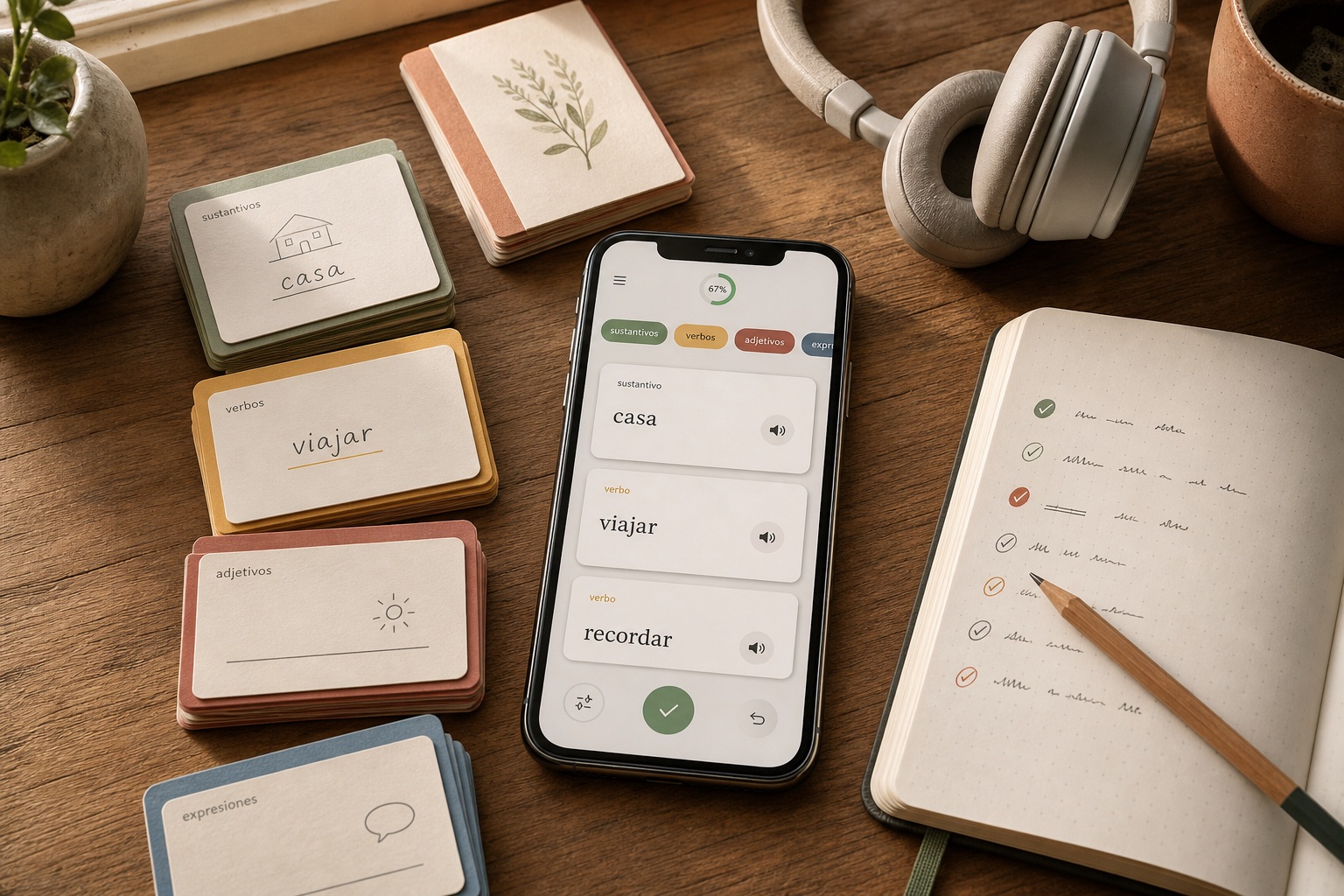
Optional Word-Level Spelling Practice with Hola Cards
This writing routine functions completely on its own with a notebook and pen. For focused spelling practice, Hola Cards offers an optional way to study selected verified words and spellings organized into custom groups. You can practice word-level writing and pronunciation with existing word audio where available, supported by adjustable spaced review. The application provides web sign-in as well as guest and offline mobile use, without offering essay assessment or custom sentence audio.