Copy Riddle Clue Vocabulary
Copy these twelve Spanish phrases along with their English glosses to practice them with audio where available.
Reading Routine
Reading with Riddles
A Spanish riddle, or adivinanza, provides enjoyable reading practice for A2–B1 learners. Paying attention to descriptions, places, and actions highlights everyday grammar and vocabulary that quick reading often skips.
Instead of guessing from a single word, test your ideas against each clue in the description. Comparing similar objects helps you see why your chosen answer fits best.
The Four-Step Evidence Routine
First, read every clue before guessing. A clue like un cuerpo de metal fits many items, but later details narrow your options.
Second, think of a close alternative. Comparing similar objects shows exactly which detail sets your answer apart.
Third, check the hint only when you get stuck. A helpful hint adds practical context without giving away the word.
Fourth, explain your answer in Spanish using es... porque... to practice connecting ideas clearly.
Clues and Meanings
Review these common Spanish descriptive phrases to spot key details in everyday riddles.
| Spanish Phrase | Meaning |
|---|---|
| cuerpo de metal | metal body |
| asa lateral | side handle |
| ranura estrecha | narrow slot |
| en el recibidor | in the hallway |
| dentro del bolsillo | inside the pocket |
| sobre un plato pequeño | on a small saucer |
| desplegar una cúpula | to open a canopy |
| girar para abrir | to turn to open |
| sostener con una mano | to hold with one hand |
| se descarta porque | is ruled out because |
| encaja con todas las pistas | fits all the clues |
| a diferencia de | unlike |
Four Clue Themes
The twelve vocabulary cards are grouped into shape, location, action, and reasoning
Movement and use
Pay attention to how the object operates and how you handle it.
desplegar una cúpula · girar para abrir · sostener con una mano
Everyday places
Notice where the object usually stays, rests, or travels.
en el recibidor · dentro del bolsillo · sobre un plato pequeño
Comparing choices
Match every clue against your idea and explain why other items do not fit.
se descarta porque · encaja con todas las pistas · a diferencia de
Shape and material
Look for what an object is made of and how its parts are shaped.
cuerpo de metal · asa lateral · ranura estrecha
Three Original Riddles
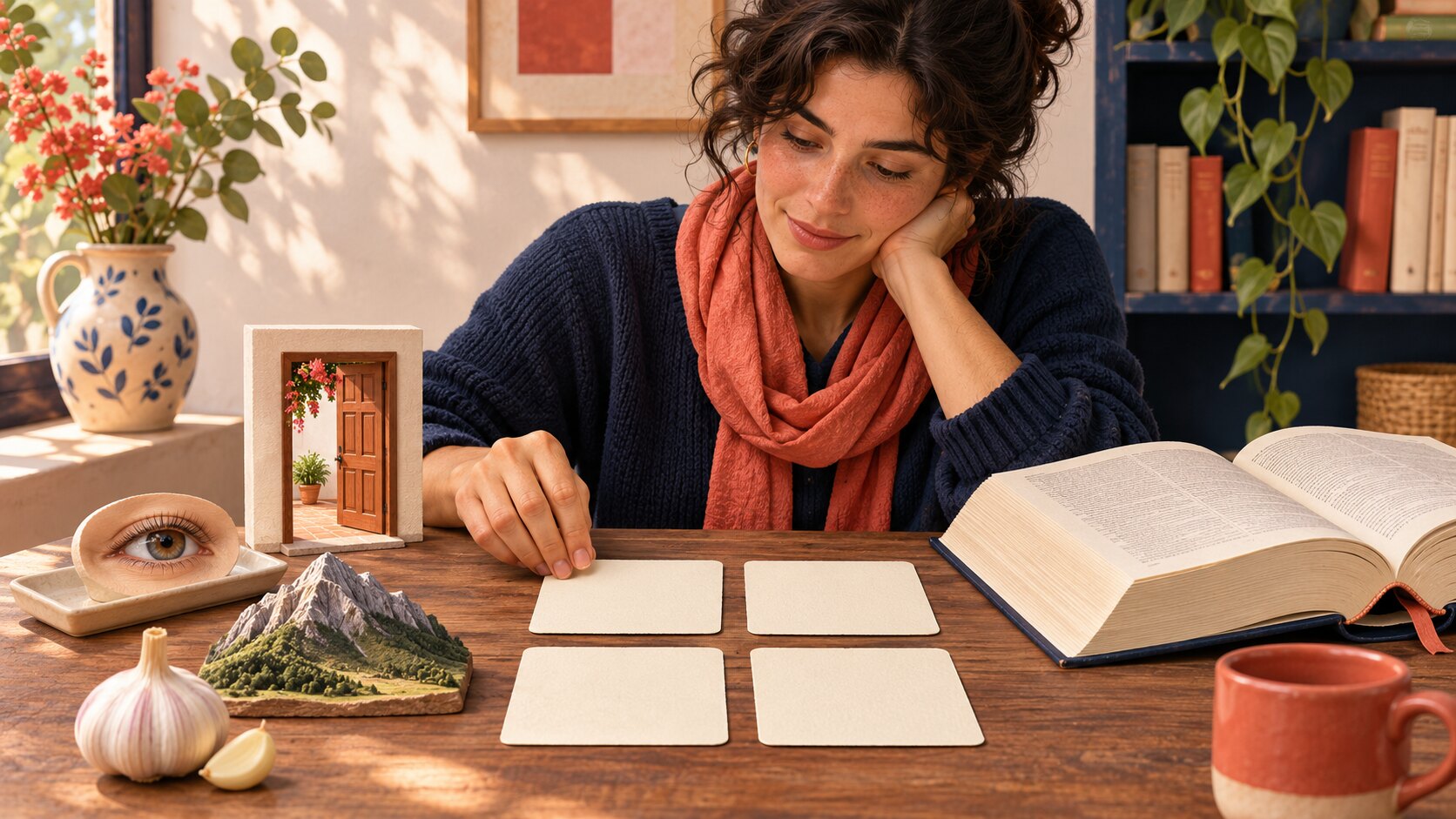
1. Tengo un cuerpo de metal con dientes pequeños. Entro en una ranura estrecha, giro para abrir y salgo para viajar en tu bolsillo. Pay attention to how this object moves and where it goes after use.
2. Descanso en un rincón cuando hay sol. Cuando llueve, despliego una cúpula de tela y me sostienes por el mango para no mojarte. Follow the weather change and how you hold this object.
3. Tengo cuerpo de cerámica y un asa lateral. Recibo café caliente cada mañana y descanso sobre un plato pequeño. Notice the material of this vessel and what rests underneath it.
Hint 1: Suele tintinear en una anilla junto a otras piezas de metal. Notice how this portable item is carried when you leave home.
Hint 2: Se sacude al entrar en un portal para no gotear en el suelo. Consider what you do with this wet object right after stepping indoors.
Hint 3: Suele acompañarse de una cucharilla para remover la bebida caliente. Think about the morning table and what goes inside this container.
1. Answer: la llave (the key). Plausible alternative: el cerrojo (the bolt). A bolt stays attached to the door and does not travel with you, whereas a key is a removable object inserted into a slot, turned, and carried in your pocket. Justification: Es la llave porque entra en la ranura, gira para abrir y vuelve a salir para viajar en el bolsillo, mientras que el cerrojo permanece fijo en la puerta.
2. Answer: el paraguas (the umbrella). Plausible alternative: el impermeable (the raincoat). A raincoat is worn over your clothes as a garment, whereas an umbrella is held overhead by a handle and unfolded during rain. Justification: Es el paraguas porque se sostiene por el mango y despliega una cúpula de tela, mientras que el impermeable se lleva puesto sobre la ropa.
3. Answer: la taza (the cup or mug). Plausible alternative: el vaso sin asa (the handleless glass). The absence of the handle alone distinguishes the particular handleless glass, whereas the mug in this riddle provides a dedicated side handle and rests on a small saucer. Justification: Es la taza porque cuenta con un asa lateral y descansa sobre un plato pequeño, mientras que el vaso sin asa carece de asa.
Explore related guides to strengthen your Spanish reading and vocabulary
Spanish Idioms by Everyday Context Spanish Words with Multiple Meanings Spanish Graded Readers for Level A2
Changing a Clue
- To practice descriptive Spanish, take a two-clue riddle and change just one detail. A single new phrase steers the description toward a completely different object while keeping the first clue true.
- Start with two clues: Tengo un cuerpo de cerámica and recibo café caliente cada mañana, which leads to la taza (the mug). If you keep the first clue and replace the second with guardo flores frescas con agua en la mesa, the answer becomes el florero (the vase). Justification: Es el florero porque tiene cuerpo de cerámica y guarda flores con agua en la mesa.
Sources and References
This activity draws on pedagogical and lexicographical references for Spanish language learning
- RAE and ASALE, DLE entry for adivinanza Describes the dictionary riddle sense as a puzzle for amusement.
- Pascuala Morote Magán, Spanish riddles in ELE (ASELE, hosted by CVC) Describes how riddles can be used in teaching Spanish as a foreign language.
- Małgorzata (Margarita) Koszla-Szymanska, riddles and puzzles as support material for Spanish teaching (AEPE, hosted by CVC) Presents classroom riddle exercises and recommends having learners create similar descriptive clues in small groups.
Frequently Asked Questions
Why are riddles useful for A2–B1 learners?
They encourage you to read descriptive words carefully, paying close attention to verbs, adjectives, and everyday prepositions.
What if my answer differs from the key?
If your alternative fits every clue in the riddle, your answer is completely valid. When one detail rules it out, use that difference to explain your choice.
How does writing explanations in Spanish help?
Writing a short sentence with es... porque... helps you practice connecting reasons, agreement, and everyday vocabulary.
Can I practice these vocabulary cards in the app?
You can import these twelve clue phrases into the Hola Cards mobile app as an optional custom group for spelling and audio practice.
Copy Riddle Clue Vocabulary
Copy these twelve Spanish phrases along with their English glosses to practice them with audio where available.
**Spanish Riddle Clue Cards**

cuerpo de metal - metal body
asa lateral - side handle
ranura estrecha - narrow slot
en el recibidor - in the hallway
dentro del bolsillo - inside the pocket
sobre un plato pequeño - on a small saucer
desplegar una cúpula - to open a canopy
girar para abrir - to turn to open
sostener con una mano - to hold with one hand
se descarta porque - is ruled out because
encaja con todas las pistas - fits all the clues
a diferencia de - unlike
Build Your Spanish Clue Vocabulary
Save these descriptive cards to your collection to practice everyday vocabulary and sentence building.