12 cards
The Core Rule for Later Events
The term gerundio de posterioridad refers to a Spanish gerund that describes an event occurring after the action of the main verb. The second edition of the DPD accepts this construction in cases of immediate succession and when there is a clear logical connection between the two events. A relationship of cause and consequence is a very common kind of logical link, but it is not the only acceptable one.
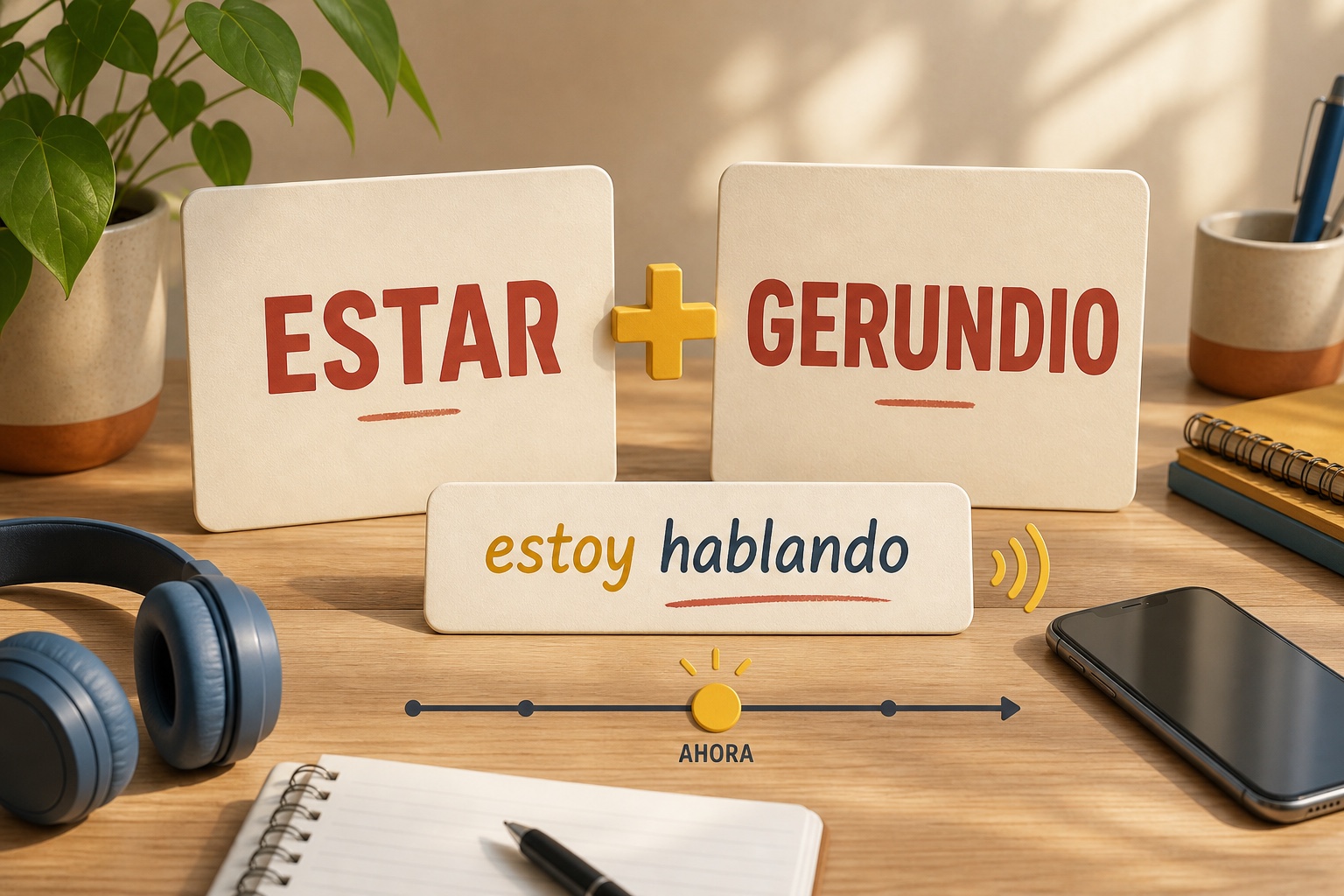
The combination estar + gerundio presents the internal progress of a single action. This guide focuses on a separate adverbial use that relates the action of the gerund to the main verb, which can involve simultaneous or later events.
Copy 12 Gerund Timing Study Cards
Copy these twelve examples directly to your clipboard for your study deck.
How Academic Standards Evaluate Later Actions
The most traditional function of the Spanish gerund is expressing overlap with the main verb. In Elena cocina escuchando la radio, both actions clearly overlap in time.
A detached gerund after a comma can show that one completed action was followed immediately by a different one from the same person. The immediacy word inside the gerund phrase signals that the second action began straight away, not at an indefinite later point. In El actor terminó el ensayo de la primera escena, dirigiéndose enseguida al camerino para cambiarse de vestuario, the actor finished rehearsing the first scene and headed to the dressing room right away to change costumes. The gerund phrase describes what happened next, not a simultaneous background activity.
A later gerund is also valid when the second event forms a clear logical consequence of the main predicate even across a delay. In El granizo dañó los viñedos, arruinando la cosecha semanas después, the crop failure is an understandable direct consequence of the storm damage.
Problems arise when writers append an unrelated later event with a gerund instead of using a coordinated clause. The sentence Lucía reparó su bicicleta en marzo de 2021, viajando a Valencia en octubre de 2023. sounds awkward because repairing a bicycle in March 2021 cannot produce or logically explain a trip to Valencia in October 2023. Because the earlier event does not account for the later one, a writer should use a finite verb instead, as in Lucía reparó su bicicleta en marzo de 2021 y viajó a Valencia en octubre de 2023.
Overview of Gerund Usage and Alternatives
Compare natural simultaneous actions, valid later consequences, and necessary finite rewrites.
| Spanish example | Meaning |
|---|---|
| Carmen camina por el parque escuchando su música favorita. | Carmen walks through the park listening to her favorite music. |
| Los niños meriendan en la cocina mirando dibujos animados. | The children have an afternoon snack in the kitchen watching cartoons. |
| Pablo apagó el ordenador, saliendo enseguida del despacho. | Pablo turned off the computer and left the office right away. |
| Marta cierra con llave la puerta principal, guardando la llave de inmediato. | Marta locks the front door and puts the key away at once. |
| El fuerte viento derribó la valla, bloqueando el sendero vecinal. | The strong wind knocked down the fence, blocking the neighborhood trail. |
| Sofía volcó el café sobre el teclado, estropeando varios circuitos. | Sofía spilled coffee on the keyboard, damaging several circuits. |
| La biblioteca digitalizó el mapa histórico local en marzo, permitiendo a los investigadores consultarlo en línea meses después, tras el cierre de la sala de lectura presencial. | The library digitized the local historical map in March, allowing researchers to consult it online months later, after the on-site reading room closed. |
| Una tormenta dañó el techo, provocando goteras semanas después. | A storm damaged the roof, causing leaks weeks later. |
| Luis fue al gimnasio el martes y asistió a la reunión el viernes. | Luis went to the gym on Tuesday and attended the meeting on Friday. |
| Clara terminó el curso de cerámica y después aprendió fotografía. | Clara finished the pottery course and afterwards learned photography. |
| Manuel limpió el trastero por la mañana y por la tarde arregló la bicicleta. | Manuel cleaned the storage room in the morning and fixed the bicycle in the afternoon. |
| Sonia visitó el museo el viernes y el domingo asistió a un concierto de guitarra. | Sonia visited the museum on Friday and on Sunday attended a guitar concert. |
Study Themes for Writing
Key linguistic categories to evaluate when deciding whether a gerund is admissible.
Simultaneity and Immediate Succession
Use the Spanish gerund when two actions happen together or when the second action begins immediately after the first.
Carmen camina por el parque escuchando su música favorita. · Los niños meriendan en la cocina mirando dibujos animados. · Pablo apagó el ordenador, saliendo enseguida del despacho. · Marta cierra con llave la puerta principal, guardando la llave de inmediato.
Logical Consequence and Outcome
A later gerund is acceptable when the context establishes a clear and intelligible cause and effect relationship.
El fuerte viento derribó la valla, bloqueando el sendero vecinal. · Sofía volcó el café sobre el teclado, estropeando varios circuitos. · La biblioteca digitalizó el mapa histórico local en marzo, permitiendo a los investigadores consultarlo en línea meses después, tras el cierre de la sala de lectura presencial. · Una tormenta dañó el techo, provocando goteras semanas después.
Independent Sequence Rewrites
Connect separate chronological events with conjugated verbs and neutral adverbs rather than unlinked gerunds.
Luis fue al gimnasio el martes y asistió a la reunión el viernes. · Clara terminó el curso de cerámica y después aprendió fotografía. · Manuel limpió el trastero por la mañana y por la tarde arregló la bicicleta. · Sonia visitó el museo el viernes y el domingo asistió a un concierto de guitarra.
Editing Practice with Contrast and Consequences
Examine this contrast pair. First read David preparó la ensalada cantando boleros and compare it with David cerró la maleta, saliendo enseguida hacia la estación. What is the distinction between these two uses, and are both acceptable in standard written Spanish?
Both sentences are fully correct. The first sentence presents simultaneous actions because singing accompanied the food preparation. The second sentence presents acceptable immediate succession because the explicit adverb enseguida marks an instant continuation without an intervening gap.
In the sentence El cine amplió la validez de las entradas en primavera, permitiendo a los clientes usarlas dos meses después, what grammatical relationship licenses the detached gerund?
This sentence is acceptable because extending the period of validity directly enables ticket use two months later through a clear cause and effect relationship. The calendar phrase indicates a time gap but does not justify the gerund. Standard Spanish permits a later gerund only because a genuine logical connection links the two events.
Now analyze this historical account from a garden project. A student wrote Sara plantó tres manzanos en primavera recogiendo peras en otoño. Identify why this phrasing feels awkward and determine how to rewrite it with a conjugated verb.
The original sentence fails because picking pears is neither immediate nor caused by planting apple trees. To fix the chronology without falsifying meaning, write Sara plantó tres manzanos en primavera y en otoño recogió peras using a finite verb.
Here is a compact checklist. First check for overlap. A later gerund may be used for an immediate sequence or a clear logical link. Choose a neutral time connector like luego for independent chronology and a result connector like por lo tanto for a consequence.
Consider two bakery situations sharing the same two-day timeline. In the first case, an earlier repair made the later bake possible, drafted as Tomás reparó el horno el jueves, horneando pan artesanal el sábado. In the second case, two unrelated chores occurred on separate days, drafted as Tomás horneó pan de nuez el jueves, pintando la despensa el sábado. Which of these gerund drafts can be kept in standard written Spanish, and how should you rewrite the other draft with a conjugated verb?
Explore related grammar guides to refine your Spanish sentence construction.
Spanish present progressive guide Using the Spanish infinitive as a noun Connecting Spanish clauses with conjunctions
Solutions and Study Routine
- You can keep the first draft because repairing the oven on Thursday directly enabled the baking on Saturday, providing a clear causal link that standard Spanish permits even across a time delay. In contrast, baking bread and painting the pantry are independent tasks without any causal relationship, making a delayed gerund unacceptable. For this unrelated case, rewrite the sentence with conjugated verbs as Tomás horneó pan de nuez el jueves y el sábado pintó la despensa, which preserves each actor, event, and stated time while avoiding artificial causation.
- Copy the example sentences, paste them into a new Hola Cards deck, then review the cards in the group.
Academic References
Consult the official language guidelines regarding gerund usage and sequence rules.
- RAE and ASALE: Diccionario panhispánico de dudas, gerundio Authoritative grammatical guidance on later action gerunds and logical relationships in modern Spanish.
- ASALE: Diccionario panhispánico de dudas, second edition Reference overview for the standard academic dictionary covering disputed usage across the Spanish speaking world.
Frequently Asked Questions
Are all gerundios de posterioridad incorrect?
No. Academic authorities accept a gerund referring to a later action when it follows in immediate succession or when there is a clear logical relation such as a result, even after a delay. They reject it only when neither condition is present.
Do the two events have to happen at the same time to use a gerund?
Overlap with the main verb is one use of the gerund. Immediate succession and a clear logical link such as cause and effect can also support a gerund that refers to a later action. An overlapping action should never be called later.
Does the word después alone allow the construction?
A temporal adverb like después can clarify the order of events but does not supply a missing semantic link for a delayed independent action.
How should writers rewrite an independent later action with a conjugated verb?
Use chronological connectors such as luego or después for simple sequence, and result connectors like por lo tanto when a consequence is intended.
Copy 12 Gerund Timing Study Cards
Copy these twelve examples directly to your clipboard for your study deck.
**Timing and the Spanish Gerund**

Carmen camina por el parque escuchando su música favorita. - Carmen walks through the park listening to her favorite music.
Los niños meriendan en la cocina mirando dibujos animados. - The children have an afternoon snack in the kitchen watching cartoons.
Pablo apagó el ordenador, saliendo enseguida del despacho. - Pablo turned off the computer and left the office right away.
Marta cierra con llave la puerta principal, guardando la llave de inmediato. - Marta locks the front door and puts the key away at once.
El fuerte viento derribó la valla, bloqueando el sendero vecinal. - The strong wind knocked down the fence, blocking the neighborhood trail.
Sofía volcó el café sobre el teclado, estropeando varios circuitos. - Sofía spilled coffee on the keyboard, damaging several circuits.
La biblioteca digitalizó el mapa histórico local en marzo, permitiendo a los investigadores consultarlo en línea meses después, tras el cierre de la sala de lectura presencial. - The library digitized the local historical map in March, allowing researchers to consult it online months later, after the on-site reading room closed.
Una tormenta dañó el techo, provocando goteras semanas después. - A storm damaged the roof, causing leaks weeks later.
Luis fue al gimnasio el martes y asistió a la reunión el viernes. - Luis went to the gym on Tuesday and attended the meeting on Friday.
Clara terminó el curso de cerámica y después aprendió fotografía. - Clara finished the pottery course and afterwards learned photography.
Manuel limpió el trastero por la mañana y por la tarde arregló la bicicleta. - Manuel cleaned the storage room in the morning and fixed the bicycle in the afternoon.
Sonia visitó el museo el viernes y el domingo asistió a un concierto de guitarra. - Sonia visited the museum on Friday and on Sunday attended a guitar concert.
Strengthen Your Spanish Sentence Structure
Organize your custom study cards and build reliable Spanish writing habits.