Clarification Questions for Study
Use these phrases to clarify naming conventions and regional preferences.
| Spanish | Meaning |
|---|---|
| ¿El certificado usa español o castellano? | Does the certificate use Spanish or Castilian? |
| ¿Este curso enseña español general? | Does this course teach general Spanish? |
| ¿El programa evalúa la lengua española? | Does the program evaluate Spanish language? |
| ¿En esta región enseñan catalán y castellano? | In this region do they teach Catalan and Spanish? |
| ¿El formulario distingue el castellano de otras lenguas? | Does the form distinguish Spanish from other languages? |
| ¿Ofrecen atención en gallego y en castellano? | Do they offer service in Galician and Spanish? |
| ¿Prefieres el término español o castellano? | Do you prefer the term Spanish or Castilian? |
| ¿Qué término usa tu familia al conversar? | Which term does your family use when speaking? |
| ¿Está bien si practicamos en español? | Is it fine if we practice in Spanish? |
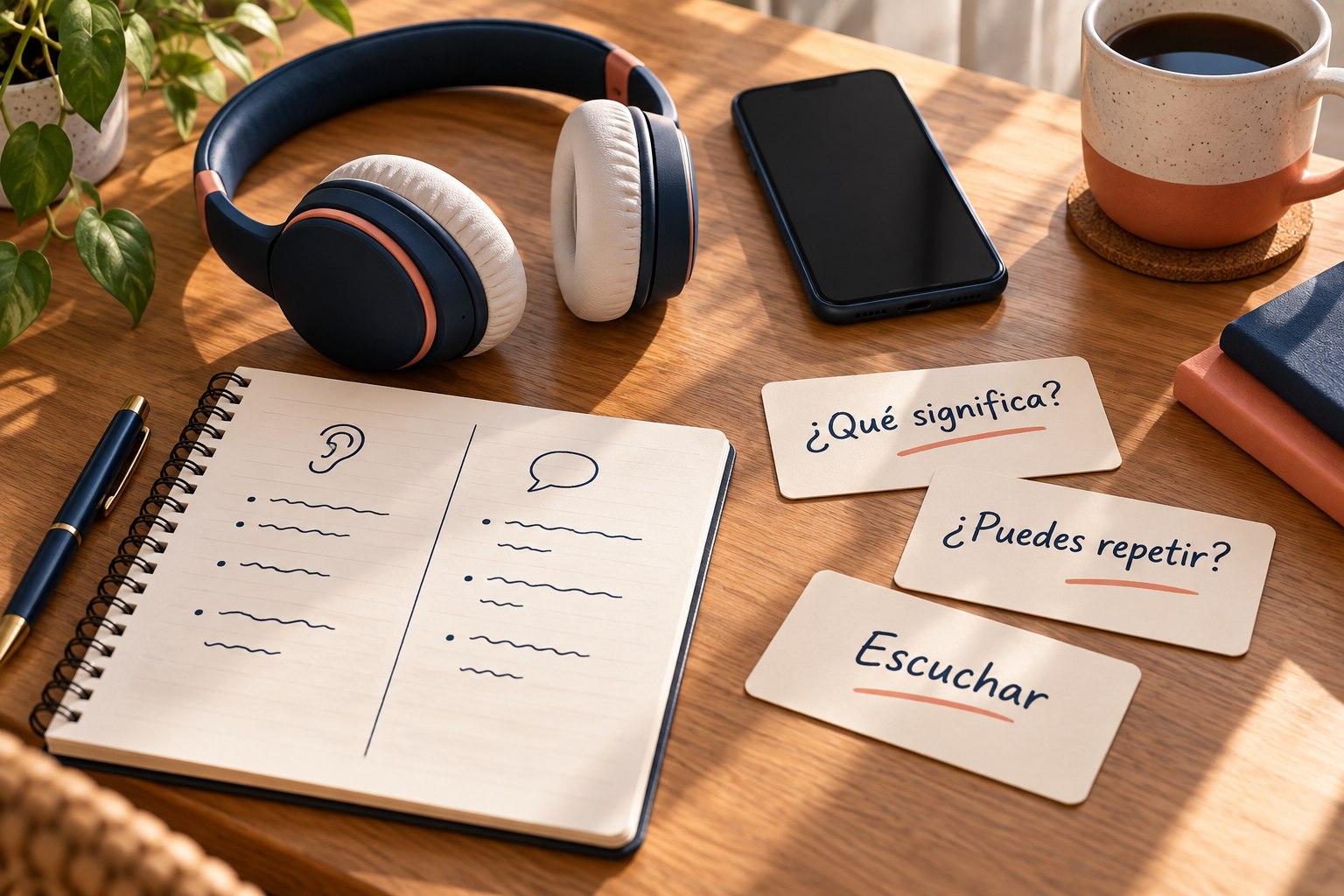
| ¿Puedo escuchar una muestra de este audiolibro? | Can I hear a sample of this audiobook? |
| ¿Las grabaciones del curso incluyen transcripciones? | Do course recordings include transcripts? |
| ¿El vocabulario del libro refleja el uso general? | Does the book's vocabulary reflect general usage? |
Study Phrases
Copy these verified clarification questions into your study group for review.
Spanish Guide
Two Names for One Language
Adult learners frequently encounter two distinct names for Spanish: español and castellano.
Instead of guessing regional accents from course titles, verify audio samples directly and practice natural clarification questions in your daily study routine.
Linguistic Consensus and Context
Language academies confirm that both español and castellano are valid names for the shared language. The RAE recommends español internationally, noting that castellano historically designated the medieval Romance of Castile, distinct from the present-day regional Spanish variety in Castile, not the same unchanged historic variety.
In Spain, institutional guidance applies castellano when distinguishing the nationwide language from coofficial languages such as Catalan, Galician, and Basque. Outside these institutional contexts, both designations remain legitimate, without academies prescribing personal pronunciation or phonetic choices.
Four Practical Contexts
Explore how context shapes course labels, regional distinctions, speaker habits, and study materials.
International Course Catalogues
Context: International Course Catalogues. In a hypothetical scenario at an invented international language academy, an adult learner reviews a course directory. The printed syllabus specifies Este curso enseña español general para adultos, meaning this course teaches general Spanish for adults. The student can infer only the stated adult general-language course, and cannot infer from the title that the syllabus lacks regional idioms. We suggest checking the actual syllabus or sample for details.
¿El certificado usa español o castellano? · ¿Este curso enseña español general? · ¿El programa evalúa la lengua española?
Audio Selection and Study Materials
Context: Audio Selection and Study Materials. While browsing an online bookstore, an independent learner evaluates digital listening resources. The product description states Este audiolibro complementario contiene grabaciones claras para principiantes, translating to this supplementary audiobook contains clear recordings for beginners. Because a storefront label alone remains insufficient to determine actual accent or audio quality, the student should listen to audio samples directly. This retail scenario demonstrates that auditioning sample tracks before buying provides genuine verification of pronunciation clarity.
¿Puedo escuchar una muestra de este audiolibro? · ¿Las grabaciones del curso incluyen transcripciones? · ¿El vocabulario del libro refleja el uso general?
Personal Interlocutor Preference
Context: Personal Interlocutor Preference. During an online conversation exchange, a study partner introduces their personal routine. The partner explains En mi familia siempre hablamos castellano con orgullo, meaning in my family we always speak Spanish with pride. Hearing this phrase, the student notes the partner's stated phrasing without attempting to deduce their geographic origin or personal motives. Within this one-on-one dialogue, the learner simply adopts that preferred term to maintain smooth, respectful communication throughout their practice session.
¿Prefieres el término español o castellano? · ¿Qué término usa tu familia al conversar? · ¿Está bien si practicamos en español?
Multilingual Regional Environments
Context: Multilingual Regional Environments. While visiting a civic center in Barcelona, a visitor notices a bilingual informational flyer. The document states El folleto ofrece servicios en castellano y en catalán, meaning the leaflet offers services in Spanish and Catalan. In this bilingual setting, the agency uses this phrasing to contrast the nationwide language with the local co-official tongue. The visitor infers that this specific office chooses the label for administrative clarity, not that every regional institution requires it.
¿En esta región enseñan catalán y castellano? · ¿El formulario distingue el castellano de otras lenguas? · ¿Ofrecen atención en gallego y en castellano?
Diagnostic Self-Check
1. Does a course titled castellano teach a separate language from español? No. Both designate the same language, though castellano can contextually denote a regional variety or historical Romance dialect.
2. Can a course label alone establish actual audio accent? No. Standalone titles cannot guarantee pronunciation, so you must sample recordings directly. 3. How should you handle a partner's naming preference? Mirror their preferred term respectfully without guessing their nationality.
Explore related guides on pronunciation and language conventions.
Neutral Spanish Accent Guide Spanish Two Surnames Explained Spanish Pronunciation for Beginners How to Use a Spanish Dictionary
Action Steps for Learners
- Check syllabi and audio previews before enrolling.
- Mirror your partner's preferred term without guessing nationality.
- Treat both words as describing identical core grammar.
- Practice verified clarification requests using spaced review.
Verified Reference Sources
Official language academies provide documented institutional reference guidance on naming conventions.
- RAE–ASALE DPD: español Validates both names for the shared language, recommending español internationally. Checked 2 November 2026.
- FundéuRAE: castellano y español Affirms both terms as appropriate synonyms without conducting frequency surveys. Checked 2 November 2026.
Frequently Asked Questions
Is castellano the same as español?
Yes. When naming the modern language, both words refer to the same global tongue, although castellano also carries specific historical and regional meanings.
Why do some speakers prefer castellano?
Speakers choose terms based on diverse personal, regional, and social traditions. When conversing with native speakers, simply ask which name they prefer without demanding an explanation.
Does castellano indicate a Spain accent?
Not necessarily. While castellano can specifically designate the regional speech of Castile, a bare label alone is insufficient for the actual recording accent. Always listen to sample audio directly.
Are Catalan and Galician dialects of castellano?
No, Catalan, Galician, and Basque are separate languages, not Spanish dialects.
Which name should beginner students use?
Beginners can safely use español as a widely understood general term, while politely adopting castellano whenever a specific partner or local setting prefers it.
Study Phrases
Copy these verified clarification questions into your study group for review.
**Clarification Questions**

¿El certificado usa español o castellano? - Does the certificate use Spanish or Castilian?
¿Este curso enseña español general? - Does this course teach general Spanish?
¿El programa evalúa la lengua española? - Does the program evaluate Spanish language?
¿En esta región enseñan catalán y castellano? - In this region do they teach Catalan and Spanish?
¿El formulario distingue el castellano de otras lenguas? - Does the form distinguish Spanish from other languages?
¿Ofrecen atención en gallego y en castellano? - Do they offer service in Galician and Spanish?
¿Prefieres el término español o castellano? - Do you prefer the term Spanish or Castilian?
¿Qué término usa tu familia al conversar? - Which term does your family use when speaking?
¿Está bien si practicamos en español? - Is it fine if we practice in Spanish?
¿Puedo escuchar una muestra de este audiolibro? - Can I hear a sample of this audiobook?
¿Las grabaciones del curso incluyen transcripciones? - Do course recordings include transcripts?
¿El vocabulario del libro refleja el uso general? - Does the book's vocabulary reflect general usage?
Enhance Your Spanish Routine
Create custom phrase groups on mobile with guest mode, or sign in on web.